Compound Overviews
What Is NAD+? A Research Overview
NAD+ is one of the most studied molecules in cellular and longevity research. This overview is for laboratory and educational reference only.
What is NAD+?
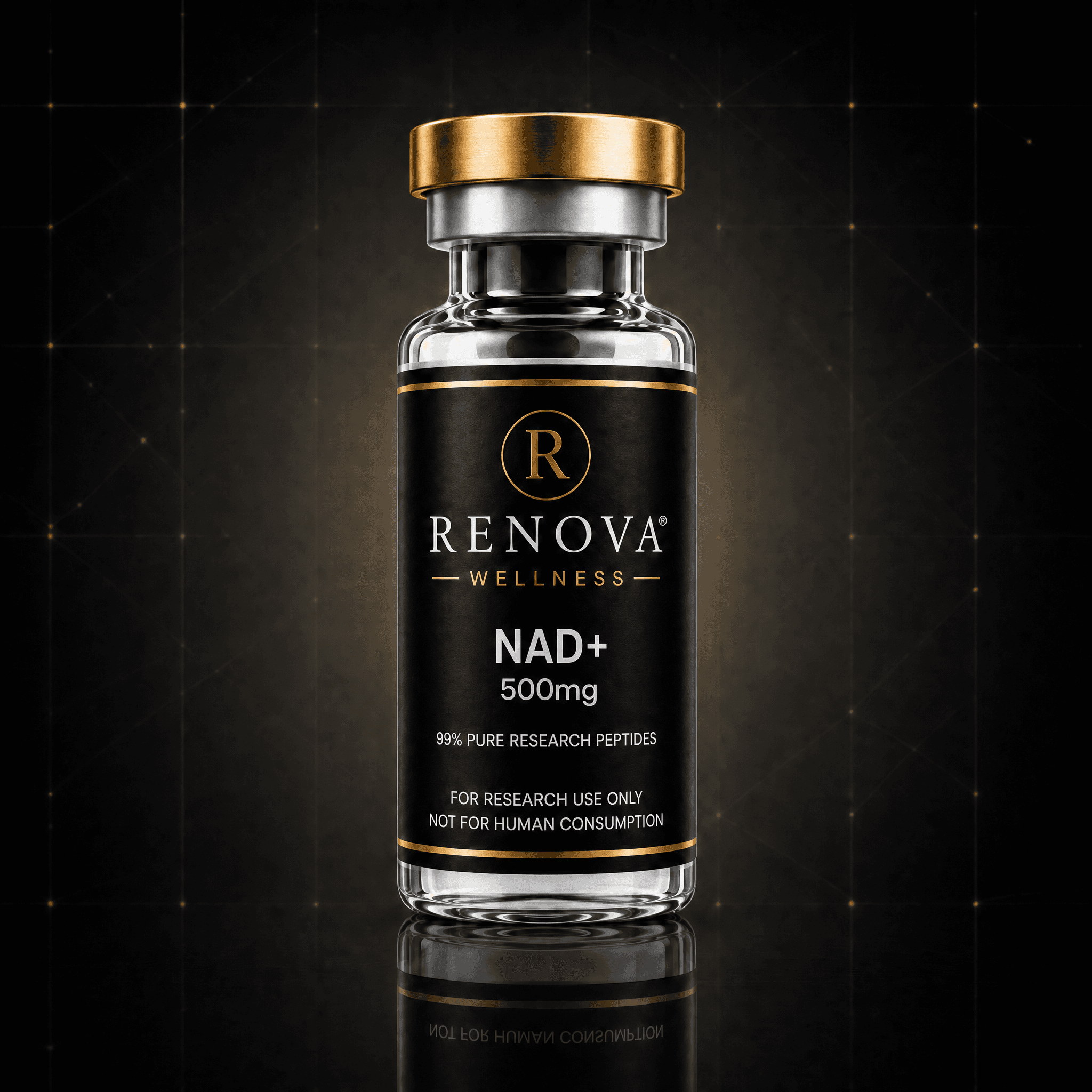
NAD+ (nicotinamide adenine dinucleotide) is a coenzyme found in all living cells. (Strictly, it's a coenzyme rather than a peptide, but it's commonly studied alongside research peptides.) It plays a central role in cellular energy metabolism and in reactions involving enzymes such as sirtuins.
What research has examined
NAD+ sits at the center of a large, active research literature spanning metabolism, mitochondrial function, and aging biology.1 Recurring themes include:
- The age-related decline. Many models report that tissue NAD+ levels fall with age — a decline linked in part to increased activity of the NAD+-consuming enzyme CD38 and associated with mitochondrial dysfunction in a sirtuin-dependent manner.2 A comprehensive review frames NAD+ metabolism as a central node in the biology of ageing.3
- Sirtuins and DNA repair. NAD+ is the required cofactor for the sirtuin family of enzymes and for PARP-mediated DNA-repair signaling — which is why NAD+ availability is studied as a limiting factor for these pathways.4
- NAD+-boosting strategies. A separate line of work evaluates precursors and other "NAD+-boosting" molecules, weighing the in-vivo evidence for raising cellular NAD+.5
These describe research observations across cell and animal models (and some human measurements), presented for reference only.
The redox role: NAD+ and NADH
Beyond signaling, NAD+ has a foundational metabolic job: it cycles between its oxidized (NAD+) and reduced (NADH) forms to shuttle electrons through central metabolism and the mitochondrial electron-transport chain. This redox cycling is how cells extract usable energy from nutrients — the "day job" that makes NAD+ indispensable independently of the sirtuin story.
NAD+ and sirtuins
The most-studied reason NAD+ matters in longevity research is its partnership with sirtuins — a family of NAD+-dependent enzymes that link a cell's energy status to gene-regulatory and repair responses.14 Because sirtuins consume NAD+ to function, the two are studied as a coupled system: when NAD+ is abundant, sirtuin activity can proceed; when it falls, that activity is constrained.
An honest note on the evidence
It is worth stating plainly: while the "NAD+ declines with age" narrative is widespread, several careful reviews caution that the human evidence is still limited and tissue-specific, and that broad claims outpace the controlled data.3 Renova presents NAD+ as a research material and makes no anti-aging, health, or therapeutic claims — the value here is giving researchers the primary sources to judge for themselves.
NAD+ vs its precursors, and a note on classification
NAD+ is a coenzyme, not a peptide; it is in the research catalog because it is routinely studied alongside mitochondrial and longevity research peptides such as MOTS-c. Much of the "NAD+" literature actually studies precursors — molecules such as nicotinamide mononucleotide (NMN) and nicotinamide riboside (NR) that cells convert into NAD+ — because precursors are often easier to deliver than the intact coenzyme. When reading a study, it is worth noting whether NAD+ itself or a precursor was used, since the two are not interchangeable in every context.
Related comparisons: NAD+ vs Glutathione · NAD+ vs Epitalon.
Handling
Supplied as a lyophilized powder; reconstitute with bacteriostatic water and store refrigerated (2–8°C) after reconstitution. See our reconstitution and storage guides. This describes laboratory handling of a research-only material.
Verified quality
Renova NAD+ ships with a per-batch third-party COA. Confirm your lot with Verify Your Vial.
References
-
Imai S, Guarente L. NAD+ and sirtuins in aging and disease. Trends Cell Biol. 2014;24(8):464–471. PMID: 24786309. ↩ ↩2
-
Camacho-Pereira J, et al. CD38 Dictates Age-Related NAD Decline and Mitochondrial Dysfunction through an SIRT3-Dependent Mechanism. Cell Metab. 2016;23(6):1127–1139. PMID: 27304511. ↩
-
Covarrubias AJ, et al. NAD+ metabolism and its roles in cellular processes during ageing. Nat Rev Mol Cell Biol. 2021;22(2):119–141. PMID: 33353981. ↩ ↩2
-
Chen C, et al. SIRT1 and aging related signaling pathways. Mech Ageing Dev. 2020;187:111215. PMID: 32084459. ↩ ↩2
-
Rajman L, Chwalek K, Sinclair DA. Therapeutic Potential of NAD-Boosting Molecules: The In Vivo Evidence. Cell Metab. 2018;27(3):529–547. PMID: 29514064. ↩
Questions
Frequently Asked
What is NAD+?
NAD+ (nicotinamide adenine dinucleotide) is a coenzyme found in every cell, central to redox reactions, mitochondrial energy production, DNA repair, and sirtuin signaling. It is a major focus of metabolism and longevity research.
Why does NAD+ matter in longevity research?
Cellular NAD+ levels are observed to decline with age in research models. Because NAD+ supports mitochondrial energy, DNA-repair enzymes, and sirtuins, restoring or maintaining NAD+ is a central question in longevity science.
How is NAD+ related to MOTS-C and SS-31?
All three are studied in mitochondrial and longevity contexts — NAD+ as a redox coenzyme, MOTS-C as a mitochondrial-derived signaling peptide, and SS-31 as a cardiolipin-binding membrane peptide. They are frequently studied alongside one another.
How is NAD+ supplied and stored?
As a lyophilized powder reconstituted with bacteriostatic water for laboratory use and refrigerated (2–8°C) afterward. Every Renova lot ships with a per-batch third-party COA.
Related Compounds
Shop the Research
Compare
Related comparisons
Keep Reading
Related Research
For Research Use Only · Not For Human Consumption · Renova Wellness™