Compound Overviews
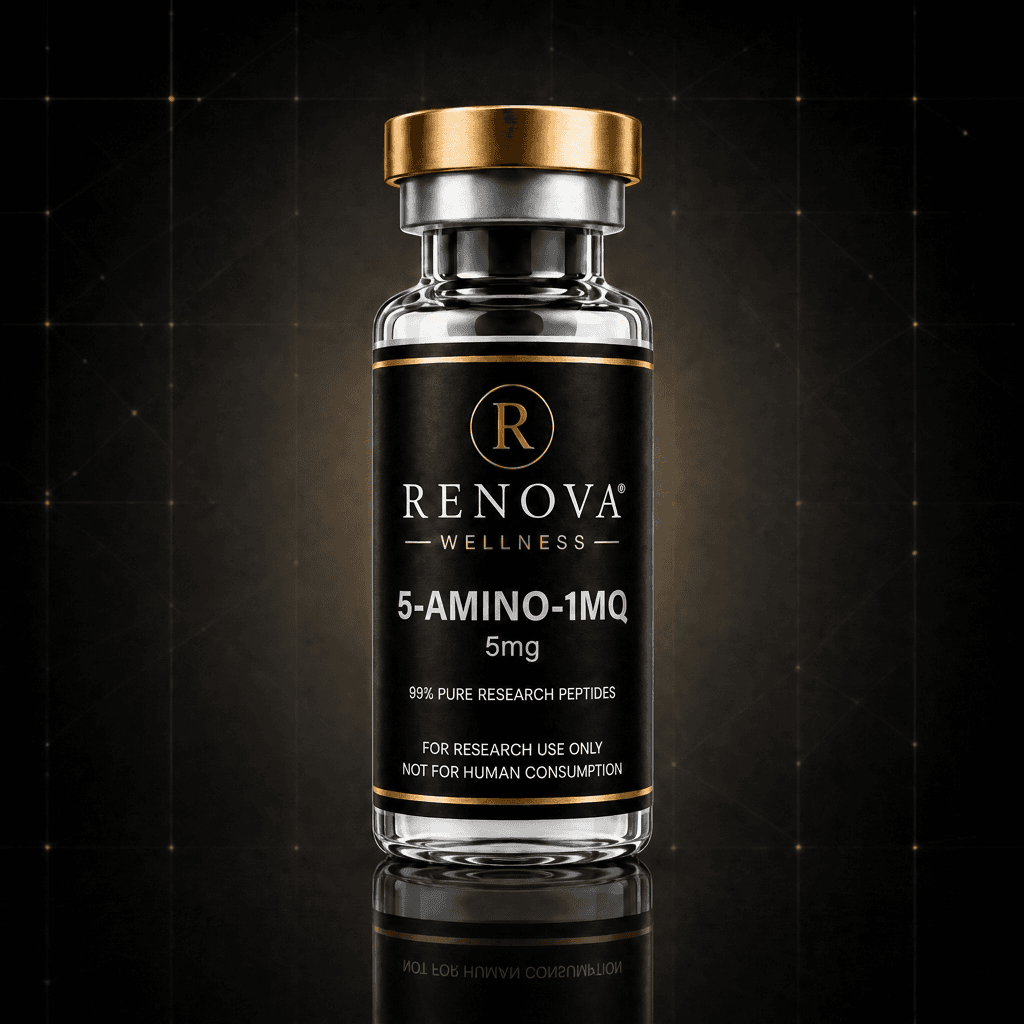
5-Amino-1MQ (NNMT Inhibitor): Research Overview
5-Amino-1MQ is a small-molecule NNMT inhibitor studied in preclinical metabolic research — a departure from the peptide catalog. This overview is for laboratory and educational reference only.
What is 5-Amino-1MQ?
5-Amino-1MQ (5-amino-1-methylquinolinium) is a small-molecule methylquinolinium compound, CAS 42464-96-0, studied as a substrate-competitive, membrane-permeable inhibitor of nicotinamide N-methyltransferase (NNMT).1 Unlike most of the Renova catalog, it is not a peptide — it is a low-molecular-weight research chemical (a heteroaromatic quinolinium salt), and it is handled and characterized accordingly.
| Property | Detail |
|---|---|
| Type | Small-molecule NNMT inhibitor (methylquinolinium) |
| Chemical class | Quinolinium salt (heteroaromatic small molecule) |
| CAS number | 42464-96-0 |
| Research target | Nicotinamide N-methyltransferase (NNMT) |
| Mechanism (studied) | Substrate-competitive, membrane-permeable inhibition |
NNMT is an enzyme that methylates nicotinamide using S-adenosylmethionine (SAM) as the methyl donor, producing 1-methylnicotinamide and S-adenosylhomocysteine.2 Because nicotinamide is a precursor in the NAD+ salvage pathway, and because SAM is the cell's principal methyl donor, NNMT activity sits at an intersection of methylation balance and NAD+ metabolism — the reason 5-Amino-1MQ is of interest as a research tool.3 Elevated NNMT expression has been reported in metabolic-tissue research — including human adipose tissue, where NNMT mRNA has been associated with markers of insulin resistance4 — which motivated the search for small-molecule inhibitors of the enzyme.
Why NNMT became a research target
Interest in NNMT as a metabolic node predates the small-molecule inhibitors. In a widely cited study, antisense knockdown of NNMT in adipose tissue and liver was reported to protect mice against diet-induced obesity, linking NNMT activity to cellular energy expenditure and NAD+/SAM balance in preclinical models.5 Review literature since has framed NNMT as "more than a vitamin B3 clearance enzyme" — a regulator sitting at the crossroads of cellular metabolism and epigenetic (methylation) control.23 That framing is what made a membrane-permeable, substrate-competitive inhibitor an attractive chemical tool: a way to probe NNMT's role directly in living cells rather than only in isolated enzyme assays.
Mechanism
5-Amino-1MQ is studied as a substrate-competitive NNMT inhibitor: its methylquinolinium scaffold resembles the enzyme's reaction environment, allowing it to occupy the active site and block methylation of nicotinamide.1 Its membrane permeability is a notable feature for cell-based research, allowing it to reach intracellular NNMT.
Because NNMT consumes nicotinamide and methyl groups, research examines whether inhibiting it can:
- shift nicotinamide handling toward the NAD+ salvage pathway,
- influence intracellular NAD+ metabolism, and
- affect adipocyte energy metabolism in metabolic models.16
These are mechanistic questions studied in the laboratory, not established outcomes. The appeal of a substrate-competitive design is specificity: rather than broadly disrupting methylation, the inhibitor is studied for engaging NNMT's active site in particular.1 Membrane permeability matters here because NNMT operates intracellularly, so a compound must cross the cell membrane to reach its target — a property that many polar enzyme inhibitors lack and that makes 5-Amino-1MQ notable as a cell-active research tool.
Research models
- Preclinical metabolic and obesity mouse models — in vivo studies in which membrane-permeable NNMT inhibitors were reported to reverse high-fat-diet-induced obesity and alter energy metabolism.16
- Adipocyte cell-culture systems — in vitro work on cellular energy handling and NAD+-linked pathways.6
- Enzyme-inhibition assays — biochemical characterization of substrate-competitive NNMT inhibition.1
- NAD+-pathway studies — research examining how NNMT inhibition intersects with nicotinamide salvage and cellular NAD+ pools.53
- Human tissue-expression studies — association work linking NNMT expression to metabolic phenotypes (context for why the enzyme is targeted, not a test of the inhibitor itself).4
All of these are laboratory and preclinical research contexts, not established uses. Renova provides 5-Amino-1MQ strictly as a reference research chemical for this kind of characterization work, with no human application intended or implied.
How it's supplied
5-Amino-1MQ is supplied as a research chemical and, in solution work, reconstituted with bacteriostatic water for laboratory use, then refrigerated at 2–8°C afterward. Because it is a small molecule rather than a lyophilized peptide, its stability profile and half-life characteristics are studied on their own terms — small-molecule quinolinium salts and peptides do not behave identically in storage. Every lot ships with a per-batch third-party COA. See Understanding Peptide Reconstitution for concentration math that applies to any research vial, and How to Store Research Peptides for general cold-chain handling.
Purity & verification
Renova 5-Amino-1MQ is third-party tested, with identity and purity documented on a per-batch certificate of analysis. Identity and purity are confirmed by HPLC and mass spectrometry, and each vial is traceable to its lot number; where relevant, endotoxin is also assessed. See How to Read a Peptide COA — the same document logic applies to a small molecule — and confirm any lot with Verify Your Vial. For the companion cofactor in NAD+-linked metabolic research, see NAD+; researchers surveying metabolic-tool compounds may also consult Metabolic Research Peptides for how this small molecule sits alongside the peptide literature.
What the research does not establish
The evidence base for 5-Amino-1MQ is almost entirely preclinical — enzyme-inhibition assays, adipocyte cultures, and rodent metabolic models.165 Human clinical evidence for this specific compound is essentially absent: there are no controlled human trials establishing safety, efficacy, dosing, or metabolic outcomes, and the broader NNMT literature is largely mechanistic and animal- or tissue-based.234 Rodent obesity findings do not translate automatically to humans, and "reverses obesity in mice" is a description of a mouse-model result, not a human claim. Renova makes no human-use, weight-loss, anti-aging, or therapeutic claims for 5-Amino-1MQ. The citations below are provided so researchers can consult the primary literature directly.
References
References
-
Neelakantan H, Vance V, Wetzel MD, et al. Selective and membrane-permeable small molecule inhibitors of nicotinamide N-methyltransferase reverse high fat diet-induced obesity in mice. Biochem Pharmacol. 2018;147:141–152. PMID: 29155147. ↩ ↩2 ↩3 ↩4 ↩5 ↩6 ↩7
-
Pissios P. Nicotinamide N-Methyltransferase: More Than a Vitamin B3 Clearance Enzyme. Trends Endocrinol Metab. 2017;28(5):340–353. PMID: 28291578. ↩ ↩2 ↩3
-
Roberti A, Fernández AF, Fraga MF. Nicotinamide N-methyltransferase: At the crossroads between cellular metabolism and epigenetic regulation. Mol Metab. 2021;45:101165. PMID: 33453420. ↩ ↩2 ↩3 ↩4
-
Kannt A, Pfenninger A, Teichert L, et al. Association of nicotinamide-N-methyltransferase mRNA expression in human adipose tissue and the plasma concentration of its product, 1-methylnicotinamide, with insulin resistance. Diabetologia. 2015;58(4):799–808. PMID: 25596852. ↩ ↩2 ↩3
-
Kraus D, Yang Q, Kong D, et al. Nicotinamide N-methyltransferase knockdown protects against diet-induced obesity. Nature. 2014;508(7495):258–262. PMID: 24717514. ↩ ↩2 ↩3
-
Kannt A, Rajagopal S, Kadnur SV, et al. A small molecule inhibitor of nicotinamide N-methyltransferase for the treatment of metabolic disorders. Sci Rep. 2018;8(1):3660. PMID: 29483571. ↩ ↩2 ↩3 ↩4
Questions
Frequently Asked
What is 5-Amino-1MQ?
5-Amino-1MQ is a small-molecule methylquinolinium compound studied as a substrate-competitive, membrane-permeable inhibitor of nicotinamide N-methyltransferase (NNMT). It is a research chemical, not a peptide.
How is 5-Amino-1MQ thought to work?
It is studied as a substrate-competitive NNMT inhibitor. By inhibiting NNMT, research examines its effects on nicotinamide handling, NAD+ metabolism, and adipocyte energy metabolism in laboratory systems.
Is 5-Amino-1MQ a peptide?
No. Unlike most of the catalog, 5-Amino-1MQ is a small-molecule research chemical (a methylquinolinium), not a peptide. It is handled and reconstituted accordingly for laboratory use.
How is 5-Amino-1MQ supplied?
As a research chemical, reconstituted with bacteriostatic water for laboratory use and refrigerated (2–8°C). Renova material ships with a per-batch third-party COA.
Related Compounds
Shop the Research
Compare
Related comparisons
Keep Reading
Related Research
For Research Use Only · Not For Human Consumption · Renova Wellness™