Compound Overviews
SNAP-8 (Acetyl Octapeptide-3): Research Overview
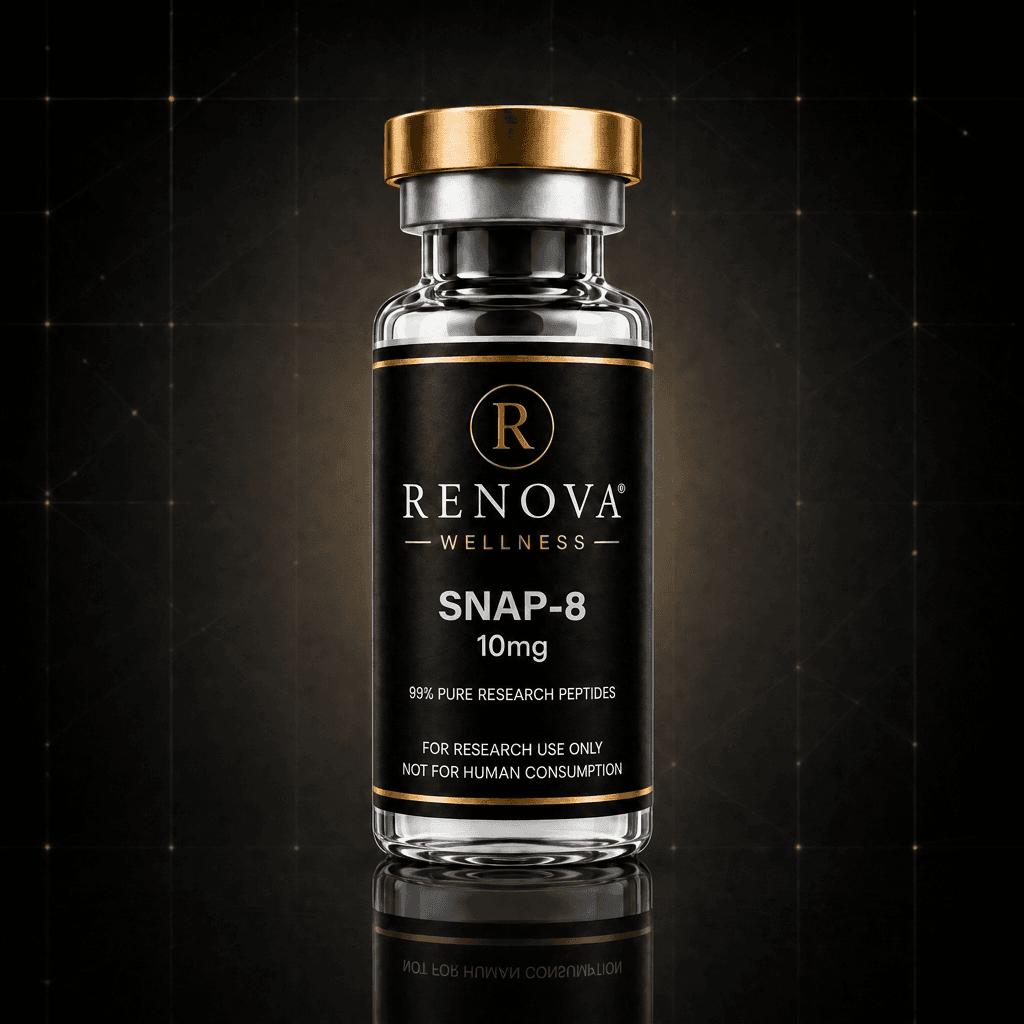
SNAP-8 is a synthetic cosmetic peptide studied as a next-generation analog of Argireline, modeled on the machinery that governs vesicle fusion. This overview is for laboratory and educational reference only.
What is SNAP-8?
SNAP-8 is Acetyl Octapeptide-3, an acetylated eight-residue peptide with the sequence Ac-EEMQRRAD-NH2 (CAS 868844-74-0; molecular weight ~1105.2). Its eight amino acids correspond to the N-terminal region of SNAP-25, one of the proteins that make up the SNARE complex.1 SNAP-8 was developed as a longer analog of Acetyl Hexapeptide-3 (Argireline),2 extending the mimicked sequence in an effort to study a more complete N-terminal fragment.
| Property | Detail |
|---|---|
| Type | Acetylated, amidated octapeptide |
| INCI name | Acetyl Octapeptide-3 |
| Sequence | Ac-Glu-Glu-Met-Gln-Arg-Arg-Ala-Asp-NH₂ (Ac-EEMQRRAD-NH₂) |
| CAS number | 868844-74-0 |
| Molecular weight | ~1105.2 |
| Parent protein | SNAP-25 (N-terminal region) |
| Related analog | Acetyl Hexapeptide-3 (Argireline) |
Because it is a short, acetylated, amidated peptide, SNAP-8 is water-soluble after reconstitution and is handled like other cosmetic research peptides. The N-terminal acetylation and C-terminal amidation are deliberate structural choices: they cap the peptide's charged termini, a common strategy in peptide chemistry studied for improving stability against exopeptidases and for more closely resembling the internal fragment of the parent protein rather than a free-standing peptide. This is one reason SNAP-8 is frequently characterized alongside Argireline in comparative cosmetic-science literature.23
Mechanism
The SNARE complex — comprising SNAP-25, syntaxin, and VAMP/synaptobrevin — mediates the docking and fusion of vesicles at the presynaptic membrane, a step required for calcium-dependent exocytosis.4 The assembling SNARE proteins zipper into a four-helix bundle that pulls the vesicle and target membranes together, and SNAP-25 contributes two of those helices, including its N-terminal domain.4
SNAP-8 is studied as a competitive mimic of the SNAP-25 N-terminus. The research hypothesis is that a peptide resembling this fragment can occupy the position normally held by native SNAP-25, thereby destabilizing or slowing SNARE-complex assembly in laboratory systems.1 The foundational demonstration for this class of peptide came from work showing that a synthetic peptide patterned on the SNAP-25 terminus could inhibit secretory-vesicle docking in chromaffin cells,1 and the same conceptual framework was later applied to the acetyl-hexapeptide (Argireline) cosmetic literature.2 Because efficient SNARE-complex formation is required for vesicle docking, a mimic that competes for the SNAP-25 position is studied for its ability to blunt the assembly step upstream of fusion.
It is useful to contrast this proposed mechanism with botulinum neurotoxin, which acts on the same machinery by a fundamentally different route: rather than competing for a position in the assembly, the toxin is a protease that enzymatically cleaves SNAP-25, permanently disabling it.5 A competitive peptide mimic and an enzymatic cleavage are distinct mechanisms with distinct kinetics and reversibility — a distinction that matters when interpreting the SNAP-8 literature, and one reason the two should not be conflated.
Lengthening the mimicked sequence from six residues to eight may, in principle, alter binding characteristics within the assembly, which is precisely the kind of structure–activity question that in vitro SNARE research is designed to address. It is important to note that this remains a mechanistic model examined in laboratory systems rather than an established biological effect for SNAP-8 specifically.
Research models
- In vitro SNARE assays — laboratory systems examining vesicle-fusion and complex-assembly dynamics.4
- Cosmetic-science models — cell-based and formulation research evaluating peptide stability and delivery.3
- Comparative peptide studies — side-by-side characterization against Acetyl Hexapeptide-3 (Argireline) and related sequences.2
- Formulation and permeation research — laboratory work on how a hydrophilic octapeptide behaves in topical cosmetic matrices.
All of these are laboratory and cosmetic-research contexts, not established uses. Renova provides SNAP-8 strictly as a reference material for this kind of characterization work, with no human application intended or implied.
What the research does not establish
The direct, peer-reviewed literature on SNAP-8 (Acetyl Octapeptide-3) specifically is very limited, and much of the mechanistic rationale is extrapolated from its shorter analog Argireline and from the broader SNARE/SNAP-25 biology rather than measured on SNAP-8 itself. Controlled human efficacy data for SNAP-8 as a topical cosmetic ingredient are sparse; the better-characterized controlled trials in this family were conducted on Argireline (Acetyl Hexapeptide-3),6 not on the octapeptide, and their results cannot simply be transferred. Nothing here should be read as evidence that SNAP-8 reduces wrinkles, relaxes muscle, or produces any cosmetic or clinical outcome in humans. Renova makes no human-use, cosmetic, or therapeutic claims. The citations below are provided so researchers can consult the primary and closely related literature directly and judge its relevance for themselves.
How it's supplied
SNAP-8 is supplied as a lyophilized powder, reconstituted with bacteriostatic water for laboratory use, and refrigerated at 2–8°C after reconstitution. Every lot ships with a per-batch third-party COA. See Understanding Peptide Reconstitution and How to Store Research Peptides.
Purity & verification
Renova SNAP-8 is research-use-only material, third-party tested, with identity and purity documented on a per-batch Certificate of Analysis — HPLC plus mass spectrometry, traceable to a lot number. See How to Read a Peptide COA, Why Peptide Purity Matters, and confirm any lot with Verify Your Vial.
References
Direct SNAP-8 literature is thin, so the list below combines the foundational SNAP-25/SNARE mimic-peptide work, authoritative SNARE and botulinum mechanism reviews, and the closely related Argireline (Acetyl Hexapeptide-3) cosmetic literature from which SNAP-8's rationale is extrapolated. Every entry is a real, verified PubMed record.
References
-
Gutierrez LM, Viniegra S, Rueda J, Ferrer-Montiel AV, Canaves JM, Montal M. A peptide that mimics the C-terminal sequence of SNAP-25 inhibits secretory vesicle docking in chromaffin cells. J Biol Chem. 1997;272(5):2634–2639. PMID: 9006897. ↩ ↩2 ↩3
-
Blanes-Mira C, Clemente J, Jodas G, et al. A synthetic hexapeptide (Argireline) with antiwrinkle activity. Int J Cosmet Sci. 2002;24(5):303–310. PMID: 18498523. ↩ ↩2 ↩3 ↩4
-
Skibska A, Perlikowska R. Signal Peptides - Promising Ingredients in Cosmetics. Curr Protein Pept Sci. 2021;22(10):716–728. PMID: 34382523. ↩ ↩2
-
Südhof TC, Rothman JE. Membrane fusion: grappling with SNARE and SM proteins. Science. 2009;323(5913):474–477. PMID: 19164740. ↩ ↩2 ↩3
-
Matak I, Lacković Z. Botulinum neurotoxin type A: actions beyond SNAP-25? Toxicology. 2015;335:79–84. PMID: 26169827. ↩
-
Wang Y, Wang M, Xiao S, Pan P, Li P, Huo J. The anti-wrinkle efficacy of argireline, a synthetic hexapeptide, in Chinese subjects: a randomized, placebo-controlled study. Am J Clin Dermatol. 2013;14(2):147–153. PMID: 23417317. ↩
Questions
Frequently Asked
What is SNAP-8?
SNAP-8 is Acetyl Octapeptide-3, an acetylated eight-residue peptide (Ac-EEMQRRAD-NH2) modeled on the N-terminal region of the SNAP-25 protein. It is studied in cosmetic-science research as an extension of the Argireline (Acetyl Hexapeptide-3) concept.
How is SNAP-8 thought to work?
Research examines SNAP-8 as a competitive mimic of the SNAP-25 N-terminus, a component of the SNARE complex involved in vesicle docking. By occupying that position, it is studied for interfering with SNARE-complex assembly in laboratory systems.
How does SNAP-8 relate to Argireline?
SNAP-8 is a longer analog of Acetyl Hexapeptide-3 (Argireline). Both are acetylated peptides derived from SNAP-25 studied for the same SNARE-modulating mechanism; SNAP-8 extends the sequence to eight residues.
How is SNAP-8 supplied?
As a lyophilized powder reconstituted with bacteriostatic water for laboratory use and refrigerated (2–8°C). Renova material ships with a per-batch third-party COA.
Related Compounds
Shop the Research
Compare
Related comparisons
Keep Reading
Related Research
For Research Use Only · Not For Human Consumption · Renova Wellness™