Compound Overviews
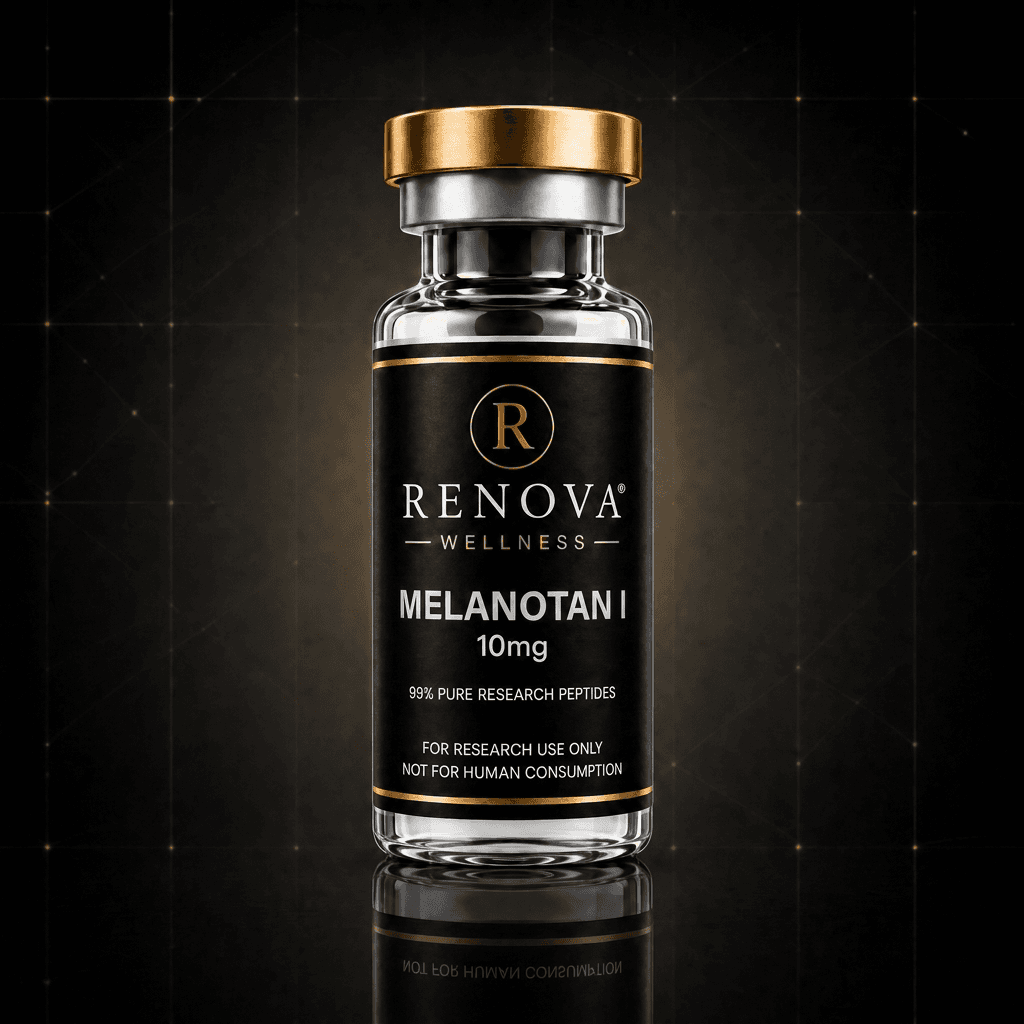
Melanotan I (Afamelanotide, MT-1): Research Overview
Melanotan I is the linear, MC1R-selective member of the melanotan analog pair, studied in pigmentation and photoprotection research. This overview is for laboratory and educational reference only.
What is Melanotan I?
Melanotan I (MT-1, also called afamelanotide) is a linear 13-amino-acid analog of α-MSH (alpha-melanocyte-stimulating hormone), with CAS 75921-69-6 and a molecular weight of ~1646.9. It corresponds to the analog first characterized as [Nle⁴-D-Phe⁷]-α-MSH (NDP-α-MSH), in which substituting norleucine at position 4 and D-phenylalanine at position 7 confers a highly potent melanotropin with markedly prolonged biological activity relative to the native hormone.1 The result is a peptide that keeps the full 13-residue backbone of α-MSH while resisting the enzymatic breakdown that limits the parent hormone, and it is studied as a comparatively MC1R-selective melanocortin agonist. This selectivity distinguishes it from the smaller, cyclic, non-selective analog Melanotan II.
| Property | Detail |
|---|---|
| Type | Linear α-MSH analog (melanocortin agonist) |
| Analog | [Nle⁴-D-Phe⁷]-α-MSH (NDP-α-MSH) |
| CAS number | 75921-69-6 |
| Molecular weight | ~1646.9 |
| Primary target | Melanocortin-1 receptor (MC1R) |
Whereas Melanotan II achieves its stability through cyclization, MT-1 keeps the linear architecture of native α-MSH and relies on targeted residue substitutions to resist enzymatic breakdown and extend its half-life. The practical consequence for research is a longer-lived analog that still presents the parent hormone's extended conformation — a useful profile when the experimental question is specifically about MC1R-driven pigment biology rather than broad melanocortin signaling.
Regulatory note: an afamelanotide-based biologic (Scenesse) is an approved therapy for erythropoietic protoporphyria (EPP).2 The material described here is a research-use-only chemical and is not that approved product.
Mechanism
MC1R is the melanocortin receptor expressed on melanocytes. It is a Gs-coupled receptor: activation by melanocortin ligands such as α-MSH stimulates adenylate cyclase, elevates intracellular cAMP, and — through downstream CREB and MITF signaling — drives the eumelanin synthesis pathway, a mechanism central to melanogenesis research.3 Because MT-1 is comparatively MC1R-selective, it is used in the laboratory as a tool to probe pigment-pathway activation with less engagement of the MC3R/MC4R/MC5R subtypes that a non-selective agonist would also stimulate.
Interest in the analog as a research tool dates to the demonstration that the synthetic melanotropin darkens human skin after subcutaneous administration — an early, controlled characterization of NDP-α-MSH's pigmentary activity in vivo.4 In photoprotection research, MC1R-driven eumelanin production is studied for its relationship to the skin's response to ultraviolet exposure — the rationale behind the EPP research program that led to the approved biologic.2 Eumelanin, the darker pigment favored by MC1R activation, is the fraction most associated with UV absorption and antioxidant/DNA-repair defenses in these models, which is why an MC1R-selective agonist is a useful tool for isolating that arm of pigment biology.5 Because MT-1 engages MC1R comparatively cleanly, researchers can attribute observed pigment-pathway responses to that receptor with fewer confounds than a non-selective agonist would introduce.
Research models
- Melanogenesis assays — melanocyte and cell-culture systems examining MC1R-driven pigment synthesis.3
- Photoprotection models — laboratory work on eumelanin production and UV-response pathways.5
- Comparative analog studies — side-by-side characterization against native α-MSH and the cyclic analog Melanotan II.1
- Receptor-selectivity work — assays comparing MC1R engagement against the MC3R/MC4R/MC5R subtypes.
All of these are laboratory and preclinical research contexts, not established uses. Renova provides Melanotan I strictly as a reference material for this kind of characterization work, distinct from the approved afamelanotide biologic, with no human application intended or implied.
What the research does not establish
The primary literature on MT-1/afamelanotide is anchored in receptor pharmacology, animal and cell-culture melanogenesis models, and a specific approved indication (EPP photoprotection) studied under clinical supervision.2 It does not establish cosmetic tanning, sunless-tanning, or any consumer use of the research chemical, and it does not validate self-administration or dosing regimens of any kind. The approved biologic is a defined pharmaceutical delivered under medical care; the research-use-only material sold here is not interchangeable with it. Renova makes no human-use, cosmetic, or therapeutic claims. The citations below are provided so researchers can consult the primary literature directly.
How it's supplied
Melanotan I is supplied as a lyophilized powder, reconstituted with bacteriostatic water for laboratory use, and refrigerated at 2–8°C after reconstitution. Every lot ships with a per-batch third-party COA. See Understanding Peptide Reconstitution and How to Store Research Peptides.
Purity & verification
Renova Melanotan I is third-party tested, with identity and purity documented on a per-batch certificate of analysis — typically HPLC for purity alongside mass spectrometry for identity confirmation. See How to Read a Peptide COA and confirm any lot with Verify Your Vial. For the non-selective cyclic analog, see Melanotan II; for another melanocortin-family analog studied on different receptor subtypes, see PT-141.
References
References
-
Sawyer TK, Sanfilippo PJ, Hruby VJ, et al. 4-Norleucine, 7-D-phenylalanine-alpha-melanocyte-stimulating hormone: a highly potent alpha-melanotropin with ultralong biological activity. Proc Natl Acad Sci U S A. 1980;77(10):5754–5758. PMID: 6777774. ↩ ↩2
-
Langendonk JG, Balwani M, Anderson KE, et al. Afamelanotide for erythropoietic protoporphyria. N Engl J Med. 2015;373(1):48–59. PMID: 26132941. ↩ ↩2 ↩3
-
Wolf Horrell EM, Boulanger MC, D'Orazio JA. Melanocortin 1 Receptor: Structure, Function, and Regulation. Front Genet. 2016;7:95. PMID: 27303435. ↩ ↩2
-
Levine N, Sheftel SN, Eytan T, et al. Induction of skin tanning by subcutaneous administration of a potent synthetic melanotropin. JAMA. 1991;266(19):2730–2736. PMID: 1658407. ↩
-
Nasti TH, Timares L. MC1R, eumelanin and pheomelanin: their role in determining the susceptibility to skin cancer. Photochem Photobiol. 2015;91(1):188–200. PMID: 25155575. ↩ ↩2
Questions
Frequently Asked
What is Melanotan I?
Melanotan I (MT-1, afamelanotide) is a synthetic linear 13-amino-acid analog of α-MSH. It is studied in research as a comparatively MC1R-selective melanocortin agonist in melanogenesis and photoprotection models.
How does Melanotan I differ from Melanotan II?
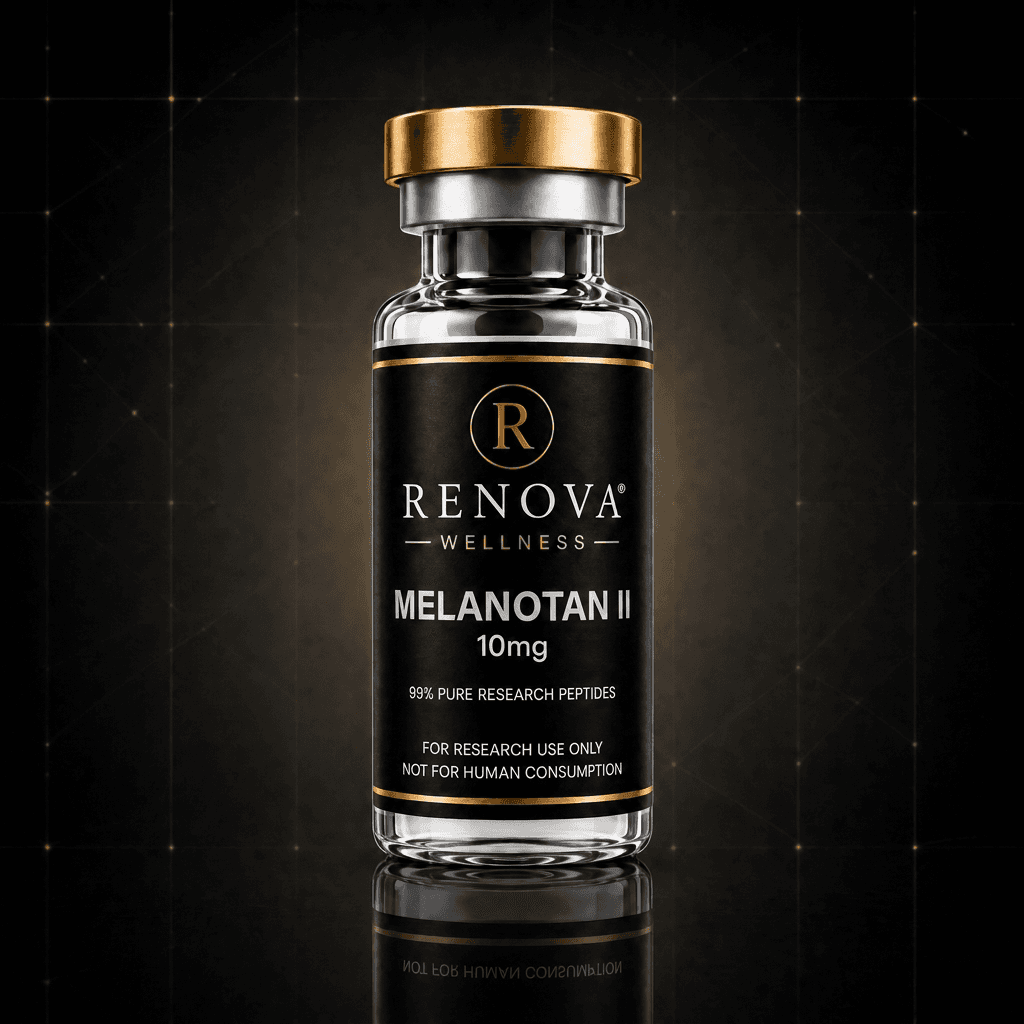
MT-1 is a linear 13-residue peptide with comparative MC1R selectivity, whereas Melanotan II is a smaller cyclic lactam analog that acts non-selectively across MC1R, MC3R, MC4R, and MC5R.
Isn't afamelanotide an approved drug?
An afamelanotide-based biologic (Scenesse) is approved for erythropoietic protoporphyria (EPP). The material described here is a research-use-only chemical and is not that approved product; nothing here is medical guidance.
How is Melanotan I supplied?
As a lyophilized powder reconstituted with bacteriostatic water for laboratory use and refrigerated (2–8°C). Renova material ships with a per-batch third-party COA.
Related Compounds
Shop the Research
Compare
Related comparisons
Keep Reading
Related Research
For Research Use Only · Not For Human Consumption · Renova Wellness™