Compound Overviews
Sermorelin (GHRH 1-29): GH-Secretagogue Fragment — Research Overview
Sermorelin is a truncated fragment of a natural releasing hormone, studied for its ability to engage the growth-hormone-releasing pathway at the pituitary. This overview is for laboratory and educational reference only.
What is Sermorelin?
Sermorelin is the N-terminal 1-29 amino-acid fragment of human growth-hormone-releasing hormone (GHRH). Full-length GHRH is a 44-residue peptide, but structure–activity research established that the first 29 residues retain the receptor-activating portion — making Sermorelin (GHRH 1-29) the minimal fully active sequence studied in this class.1 Work on the parent hormone mapped the biological activity to this N-terminal region, so truncating at residue 29 preserves receptor engagement while yielding a shorter, more tractable molecule for laboratory synthesis and characterization.1
| Property | Detail |
|---|---|
| Type | GHRH-analog peptide fragment |
| Sequence | GHRH (1-29) — first 29 amino acids of human GHRH, C-terminal amide |
| CAS number | 86168-78-7 |
| Molecular weight | ≈ 3357.9 Da |
| Synthesis | Solid-phase peptide synthesis (29 residues) |
Reference identifiers used across the literature and catalog documentation include CAS 86168-78-7 and a molecular weight of approximately 3357.9 Da. The naming convention "GHRH 1-29" reflects exactly what the fragment is: residues 1 through 29 of the parent hormone.
Mechanism
Sermorelin is an agonist of the GHRH receptor (GHRHR) on the anterior pituitary.2 The GHRHR is a G-protein-coupled receptor whose activation, in the somatotroph cells that produce growth hormone, couples to the cAMP signaling pathway and drives both synthesis and secretion of endogenous growth hormone (GH).2 In preclinical and clinical characterizations, GHRHR activation by GHRH(1-29) is associated with stimulation of GH release from these pituitary somatotrophs.34
This is a mechanistically distinct approach from administering growth hormone directly: rather than supplying the hormone, Sermorelin is studied for engaging the upstream releasing pathway. Research characterizations describe a short half-life on the order of 10–20 minutes, reflecting the rapid clearance typical of releasing-hormone fragments, which are subject to N-terminal degradation by circulating peptidases.5
Because it acts at the level of the pituitary rather than downstream, Sermorelin is often positioned in research as a secretagogue — a molecule studied for prompting secretion of an endogenous hormone. This upstream position is what distinguishes it from directly supplied recombinant growth hormone and from IGF-1 analogs that act further along the axis at the IGF-1 receptor. The short half-life means that, in laboratory models, the signal from GHRHR activation is pulsatile and time-limited, a property researchers weigh when designing experiments.5
Research models
Preclinical and laboratory studies involving Sermorelin (GHRH 1-29) have examined:
- Pituitary GH secretion — models of somatotroph stimulation, including studies comparing GH release after GRF(1-44), GRF(1-40), and GRF(1-29) in normal subjects.4
- GHRH-receptor pharmacology — agonism, receptor coupling, and the regulation of somatotroph function by the GHRH receptor.2
- Neuroendocrine assessment — GRF(1-29)NH₂ used as a probe of pituitary GH reserve alongside somatomedin-C measurements in the evaluation of growth-hormone deficiency.6
These are strictly laboratory, clinical-research, and preclinical contexts characterizing the GHRH-receptor pathway. They are provided so researchers can consult the primary literature; they are not evidence of any outcome outside those study settings.
How it's supplied
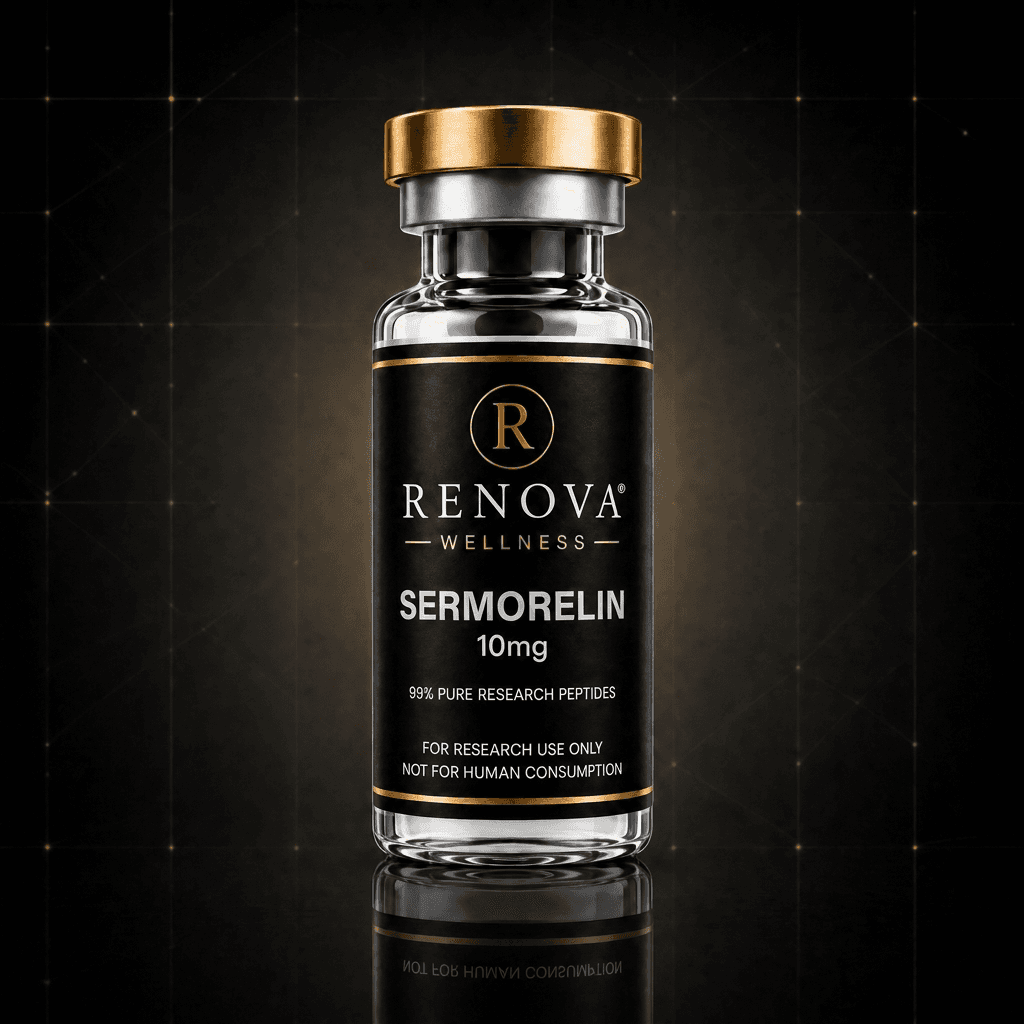
Renova supplies Sermorelin as a lyophilized powder. For laboratory work it is reconstituted with bacteriostatic water, then kept refrigerated at 2–8°C. As a releasing-hormone fragment with a short in-solution half-life, it is handled and stored with the same care given other labile peptides. Every unit ships with a per-batch third-party COA.
See Understanding Peptide Reconstitution and How to Store Research Peptides for general handling references.
Purity & verification
Renova material is third-party tested, with identity and purity documented on a per-batch certificate of analysis. Identity and mass are confirmed by HPLC and mass spectrometry, with endotoxin screening and a traceable lot number on each batch. For releasing-hormone fragments like Sermorelin, the COA is the primary reference for confirming that a given lot matches its stated sequence, mass, and purity. See How to Read a Peptide COA and confirm any lot with Verify Your Vial.
What the research does not establish
The Sermorelin literature characterizes GHRH-receptor pharmacology and, in clinical-research settings, the acute GH response to GHRH(1-29) as a diagnostic probe.346 It does not establish any consumer, anti-aging, performance, or therapeutic use in the context in which Renova sells this material. Findings describing GH secretion in study subjects do not translate to any outcome, benefit, or protocol outside those studies, and Renova makes no human-use claims. The citations below are provided so researchers can consult the primary literature directly, and concentration math for any vial size can be worked out with our reconstitution calculator.
Related comparisons
Researchers comparing secretagogue approaches may also review CJC-1295 vs Ipamorelin, Tesamorelin — another GHRH-analog — and IGF-1 LR3, which sit at different points along the GH/IGF signaling axis.
Verified quality
Renova Sermorelin ships with a per-batch third-party COA. Confirm your lot with Verify Your Vial.
References
-
Rivier J, Rivier C, Galyean R, Yammamoto G, Vale W. Potent long-acting growth hormone releasing factor analogues. Ann N Y Acad Sci. 1988;527:44–50. PMID: 3133968. ↩ ↩2
-
Mayo KE, Miller T, DeAlmeida V, Godfrey P, Zheng J, Cunha SR. Regulation of the pituitary somatotroph cell by GHRH and its receptor. Recent Prog Horm Res. 2000;55:237–266. PMID: 11036940. ↩ ↩2 ↩3
-
Prakash A, Goa KL. Sermorelin: a review of its use in the diagnosis and treatment of children with idiopathic growth hormone deficiency. BioDrugs. 1999;12(2):139–157. PMID: 18031173. ↩ ↩2
-
Losa M, Schopohl J, Müller OA, von Werder K. Stimulation of growth hormone secretion with human growth hormone releasing factors (GRF1-44, GRF1-40, GRF1-29) in normal subjects. Klin Wochenschr. 1984;62(23):1140–1143. PMID: 6240568. ↩ ↩2 ↩3
-
Walker RF. Sermorelin: a better approach to management of adult-onset growth hormone insufficiency? Clin Interv Aging. 2006;1(4):307–308. PMID: 18046908. ↩ ↩2
-
Ranke MB, Gruhler M, Rosskamp R, Brügmann G, Attanasio A, Blum WF, Bierich JR. Testing with growth hormone-releasing factor (GRF(1-29)NH2) and somatomedin C measurements for the evaluation of growth hormone deficiency. Eur J Pediatr. 1986;145(6):485–492. PMID: 2880720. ↩ ↩2
Questions
Frequently Asked
What is Sermorelin?
Sermorelin is the N-terminal 1-29 amino-acid fragment of human growth-hormone-releasing hormone (GHRH). This fragment retains the receptor-activating portion of the full hormone and is studied in research as an agonist of the GHRH receptor.
How does Sermorelin work in research models?
Sermorelin acts as an agonist of the GHRH receptor on the pituitary. In preclinical models, GHRH-receptor activation is associated with stimulation of endogenous growth-hormone secretion, in contrast to administering growth hormone directly.
What research models has Sermorelin been studied in?
Preclinical and laboratory research has examined Sermorelin in the context of pituitary growth-hormone secretion and GHRH-receptor pharmacology. These are laboratory and preclinical contexts only.
How is Sermorelin supplied?
As a lyophilized powder reconstituted with bacteriostatic water for laboratory use and refrigerated (2–8°C) afterward. Renova material ships with a per-batch third-party COA.
Related Compounds
Shop the Research
Compare
Related comparisons
Keep Reading
Related Research
For Research Use Only · Not For Human Consumption · Renova Wellness™