Compound Overviews
What Is Tesamorelin? A Research Overview
Tesamorelin is a synthetic peptide studied in metabolic and endocrine research. This overview is for laboratory and educational reference only.
What is tesamorelin?
Tesamorelin is a synthetic analog of growth-hormone-releasing hormone (GHRH) — a stabilized version of the GHRH(1–44) sequence engineered to resist rapid breakdown, giving it a longer effective half-life than native GHRH. As a GHRH analog it acts as a secretagogue: rather than supplying growth hormone directly, it is studied for prompting the pituitary to release the body's own growth hormone in a pulsatile pattern. In receptor terms it is a GHRH-receptor agonist, and it belongs to the broader family of research peptides that act on the growth-hormone axis.
Why the "endogenous release" distinction matters
A recurring theme in the tesamorelin literature is the contrast between stimulating growth-hormone release and administering growth hormone. Because a GHRH analog works upstream — at the pituitary — the resulting growth-hormone pulses remain subject to the body's normal feedback loops (for example, somatostatin regulation). Researchers cite this as the mechanistic reason tesamorelin has been studied as a distinct approach from exogenous growth hormone, and it is the same axis that GHRH analogs such as CJC-1295 are studied within.
What research has examined
Tesamorelin is one of the more clinically characterized compounds in this catalog: it is the subject of published, controlled human trials, most concentrated in one research population — HIV-associated lipodystrophy (excess visceral abdominal fat). These references describe research findings only and do not describe any use of Renova's research material, which is supplied strictly for laboratory study.
- Visceral adipose tissue. In randomized, placebo-controlled trials in patients with HIV-associated abdominal fat accumulation, tesamorelin was reported to reduce visceral adipose tissue (VAT) over 26 weeks, with the reduction described as being maintained through longer extension phases in participants who continued treatment.1 A dedicated review summarizes an approximate 18% VAT reduction across the pooled trial data.2
- Liver fat. A later randomized clinical trial examined tesamorelin's effect on visceral fat and hepatic fat, reporting reductions in liver-fat content in the studied population.3
- Growth-hormone axis in other settings. Beyond the lipodystrophy trials, a randomized controlled study examined the metabolic effects of the GHRH analog in obese subjects with reduced growth-hormone secretion, situating tesamorelin within broader metabolic-research contexts.4
Tesamorelin has an approved therapeutic indication in one specific clinical population (HIV-associated lipodystrophy);5 that regulatory status applies to a finished pharmaceutical product used under medical supervision and is not a statement about Renova's research material, which is sold solely for laboratory study and is not for human use.
The GHRH-analog family
Tesamorelin is frequently discussed alongside other GHRH analogs studied on the same axis. For how these secretagogues are grouped and compared, see CJC-1295 vs Ipamorelin, and for the mechanics of the wider peptide category, What Are Research Peptides?.
What the research does not establish
The strongest tesamorelin evidence is specific to a defined clinical population and a finished, regulated drug product. It does not establish safety, efficacy, or any outcome for Renova's research-grade material, for other populations, or for any non-clinical use. Renova makes no human-use claims; the citations below are provided so researchers can consult the primary literature directly.
Tesamorelin vs CJC-1295 vs exogenous growth hormone
| Approach | What it is | How it is studied to act |
|---|---|---|
| Tesamorelin | Stabilized GHRH(1–44) analog | Prompts pulsatile endogenous GH release at the pituitary; longer-acting than native GHRH |
| CJC-1295 | GHRH analog (with or without DAC) | Also a GHRH-axis secretagogue; the DAC variant is engineered for a longer half-life |
| Exogenous GH | Recombinant growth hormone itself | Supplies the hormone directly, bypassing the GHRH pulse and its feedback |
The common thread among the analogs is that they act upstream — stimulating the body's own release rather than replacing the hormone — which is the mechanistic reason they are studied as a distinct category from recombinant GH. For how the GHRH-analog and GH-secretagogue families are grouped, see CJC-1295 vs Ipamorelin.
Related comparisons: Tesamorelin vs CJC-1295/Ipamorelin · Tesamorelin vs MOTS-c.
Handling
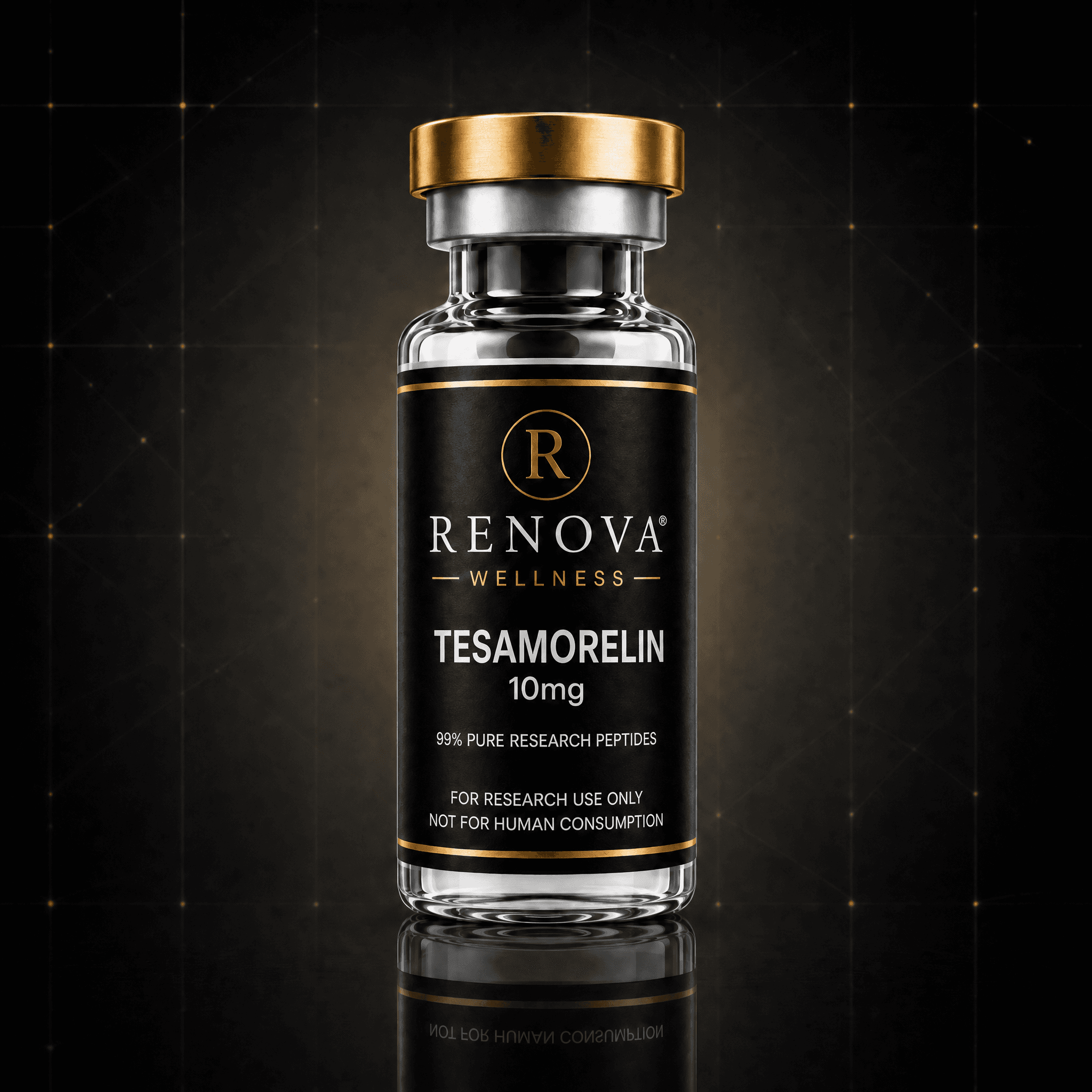
Supplied as a lyophilized powder; reconstitute with bacteriostatic water and store refrigerated (2–8°C) after reconstitution. Because tesamorelin is handled like other growth-hormone-axis research peptides, the same concentration and cold-chain considerations apply — see our reconstitution and storage guides for the calculations and handling.
Verified quality
Renova Tesamorelin ships with a per-batch third-party COA. Confirm your lot with Verify Your Vial.
References
-
Falutz J, et al. Effects of tesamorelin, a growth hormone-releasing factor, in HIV-infected patients with abdominal fat accumulation: a randomized placebo-controlled trial with a safety extension. J Acquir Immune Defic Syndr. 2010;53(3):311–322. PMID: 20101189. ↩
-
Spooner LM, Kalabalik J. Tesamorelin: a growth hormone-releasing factor analogue for HIV-associated lipodystrophy. Ann Pharmacother. 2012;46(2):240–247. PMID: 22298602. ↩
-
Stanley TL, et al. Effect of tesamorelin on visceral fat and liver fat in HIV-infected patients with abdominal fat accumulation: a randomized clinical trial. JAMA. 2014;312(4):380–389. PMID: 25038357. ↩
-
Makimura H, et al. Metabolic effects of a growth hormone-releasing factor in obese subjects with reduced growth hormone secretion: a randomized controlled trial. J Clin Endocrinol Metab. 2012;97(12):4769–4779. PMID: 23015655. ↩
-
Wang Y, et al. Tesamorelin, a human growth hormone releasing factor analogue. Expert Opin Investig Drugs. 2009;18(3):303–310. PMID: 19243281. ↩
Questions
Frequently Asked
What is Tesamorelin?
Tesamorelin is a synthetic, stabilized analog of growth-hormone-releasing hormone (GHRH). It is studied for stimulating pulsatile endogenous growth-hormone release, in contrast to administering growth hormone directly.
What is Tesamorelin most studied for?
The most-studied research angle is reduction of visceral and hepatic fat. It is also discussed in the context of the GHRH axis and metabolic research.
How is Tesamorelin different from CJC-1295 and from exogenous GH?
Tesamorelin and CJC-1295 are both GHRH analogs studied for stimulating the body's own growth-hormone pulse, whereas exogenous growth hormone supplies the hormone directly. The analogs differ in their structures and stability.
How is Tesamorelin supplied and stored?
As a lyophilized powder reconstituted with bacteriostatic water for laboratory use and refrigerated (2–8°C) afterward. Every Renova lot ships with a per-batch third-party COA.
Related Compounds
Shop the Research
Compare
Related comparisons
Keep Reading
Related Research
For Research Use Only · Not For Human Consumption · Renova Wellness™