Compound Overviews
IGF-1 LR3: Long-Acting IGF-1 Analog — Research Overview
IGF-1 LR3 is an engineered, long-acting analog of a well-characterized growth factor, studied for its prolonged activity in cell and tissue models. This overview is for laboratory and educational reference only.
What is IGF-1 LR3?
IGF-1 LR3 (Long R3 Insulin-like Growth Factor 1) is a recombinant 83-amino-acid analog of native IGF-1. It differs from the parent molecule in two engineered ways: an arginine-for-glutamate substitution at position 3 (the "R3") and a 13-residue N-terminal extension (the "Long").1 Together, these modifications reduce the analog's affinity for the insulin-like growth factor binding proteins (IGFBPs) that normally sequester circulating IGF-1.1
Key reference identifiers used in the literature and on catalog documentation include CAS 946870-92-4 and a molecular weight of approximately 9117.5 Da. Because IGF-1 LR3 is a single-chain polypeptide of 83 residues, it is produced by recombinant expression rather than solid-phase synthesis, and its full-length structure is characterized by mass spectrometry rather than the shorter-sequence methods used for tripeptides.
| Property | Detail |
|---|---|
| Type | Recombinant IGF-1 analog (single-chain polypeptide) |
| Length | 83 amino acids |
| Engineered changes | Glu→Arg at position 3; 13-residue N-terminal extension |
| CAS number | 946870-92-4 |
| Molecular weight | ~9117.5 Da |
| Primary receptor | IGF-1R (receptor tyrosine kinase) |
Native IGF-1 is a 70-amino-acid single-chain polypeptide. The two engineering changes in IGF-1 LR3 are additive: the position-3 arginine substitution alters a residue implicated in binding-protein contact, while the N-terminal extension lengthens the chain by 13 residues.1 Neither change is intended to alter the receptor-binding face itself, which is why research characterizes the analog as retaining IGF-1R engagement while shifting its binding-protein behavior.1 Solution-structure work using multidimensional NMR has since mapped the analog's backbone and confirmed that its core fold mirrors that of native IGF-1, with the N-terminal extension appearing as a largely unstructured addition rather than a refolding of the receptor-binding domain.23
Mechanism
Native IGF-1 signals through the IGF-1 receptor (IGF-1R), a receptor tyrosine kinase that activates downstream pathways associated with growth, proliferation, and anabolic signaling.4 In research models, IGF-1 LR3 also acts at IGF-1R.14
The functional distinction is pharmacokinetic. Circulating IGF-1 is largely bound to a family of six high-affinity IGF-binding proteins, which act as a reservoir and limit how much ligand is free to engage the receptor at any moment.5 The Arg3 substitution and N-terminal extension lower IGFBP affinity, so a greater proportion of the analog remains unbound in laboratory systems.15 In cultured cells that secrete IGFBPs, this reduced sequestration is the reported basis for the analog's enhanced biological potency relative to native IGF-1 — the change is driven by binding-protein interactions rather than by tighter receptor binding.1 This is also the structural rationale for the prolonged activity reported for IGF-1 LR3, with a half-life on the order of 20–30 hours described in research characterizations — substantially longer than the minutes-scale clearance of native IGF-1.
Research models
Preclinical and laboratory studies involving IGF-1 LR3 and closely related low-IGFBP-affinity variants have examined:
- Cell growth — proliferation assays in cultured cell lines, where reduced IGFBP sequestration increases the free ligand available to IGF-1R.1
- Proliferation and differentiation — models probing IGF-1R-driven signaling pathways.4
- Anabolic signaling — tissue and cell models of protein-synthesis-associated signaling. In one comparative animal study, IGF-1 variants that bind IGFBPs poorly (including the LR3 variant) were reported to be substantially more potent than native IGF-1 in a catabolic model.6
These are strictly laboratory and preclinical research contexts, not established or approved uses. The prolonged activity profile reported for the analog is one reason it appears frequently in time-course experiments, where the longer window between clearance and receptor engagement is a variable of interest. Study of the analog in any of these models does not imply a validated outcome, and results in cell or animal systems do not translate to any human or animal application.
What the research does not establish
The evidence base for IGF-1 LR3 is preclinical and limited — recombinant-protein characterization, structural NMR studies, cultured-cell potency assays, and animal models of anabolism. Much of the primary literature dates from the analog's development as a research and cell-culture reagent, and the strongest claims that can be supported are comparative (LR3 versus native IGF-1 in defined laboratory systems), not clinical. There are no controlled human trials establishing safety or efficacy for any use, and Renova makes no human-use, performance, or therapeutic claims. The citations below are provided so researchers can consult the primary literature directly and judge the evidence for themselves.
How it's supplied
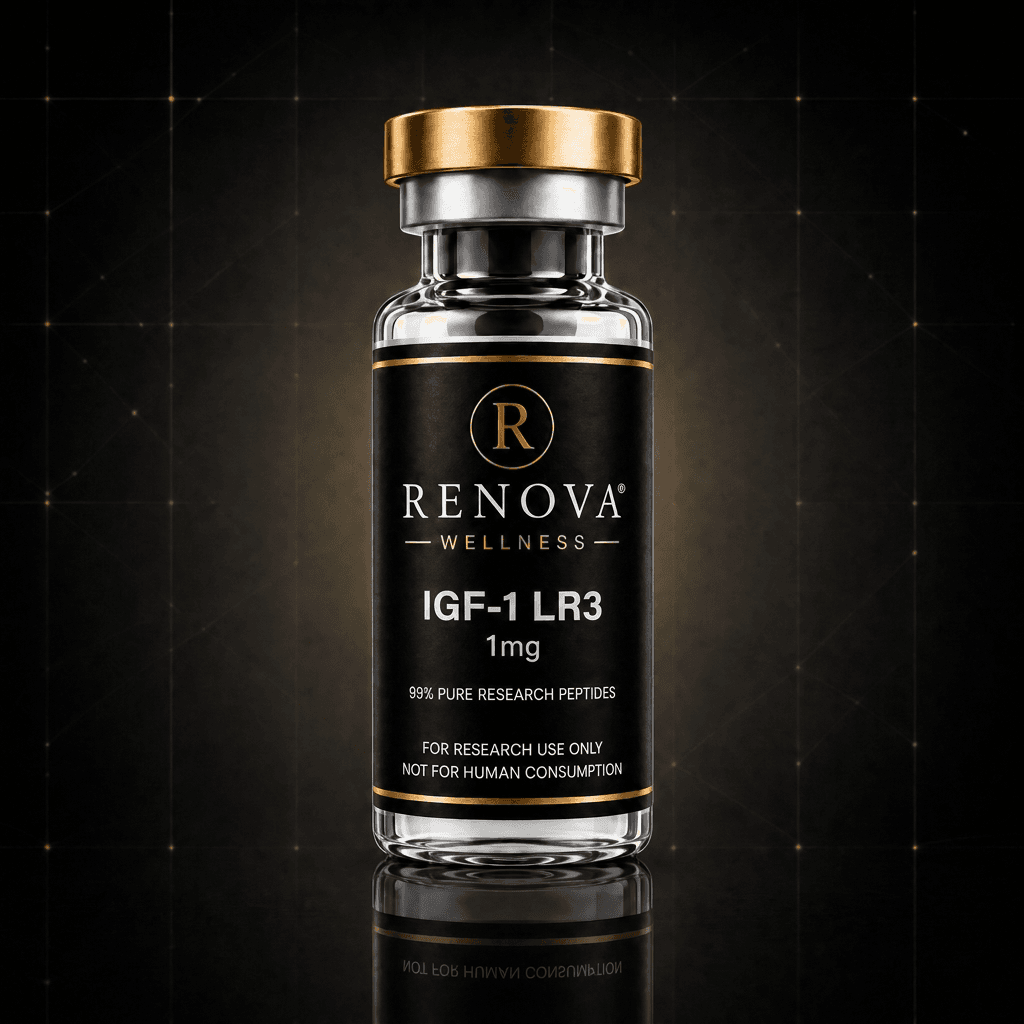
Renova supplies IGF-1 LR3 as a lyophilized powder. For laboratory work it is reconstituted with bacteriostatic water, then kept refrigerated at 2–8°C. Every unit ships with a per-batch third-party COA.
See Understanding Peptide Reconstitution and How to Store Research Peptides for general handling references, and the reconstitution calculator for working out concentrations for any vial size.
Purity & verification
Renova material is third-party tested, with identity and purity documented on a per-batch certificate of analysis. For growth-factor analogs like IGF-1 LR3, the COA is the primary reference for confirming that a given lot matches its stated identity, mass, and purity — typically via HPLC for purity and mass spectrometry for the intact-mass identity check that a full-length 83-residue polypeptide requires. See How to Read a Peptide COA, understand why peptide purity matters, and confirm any lot with Verify Your Vial.
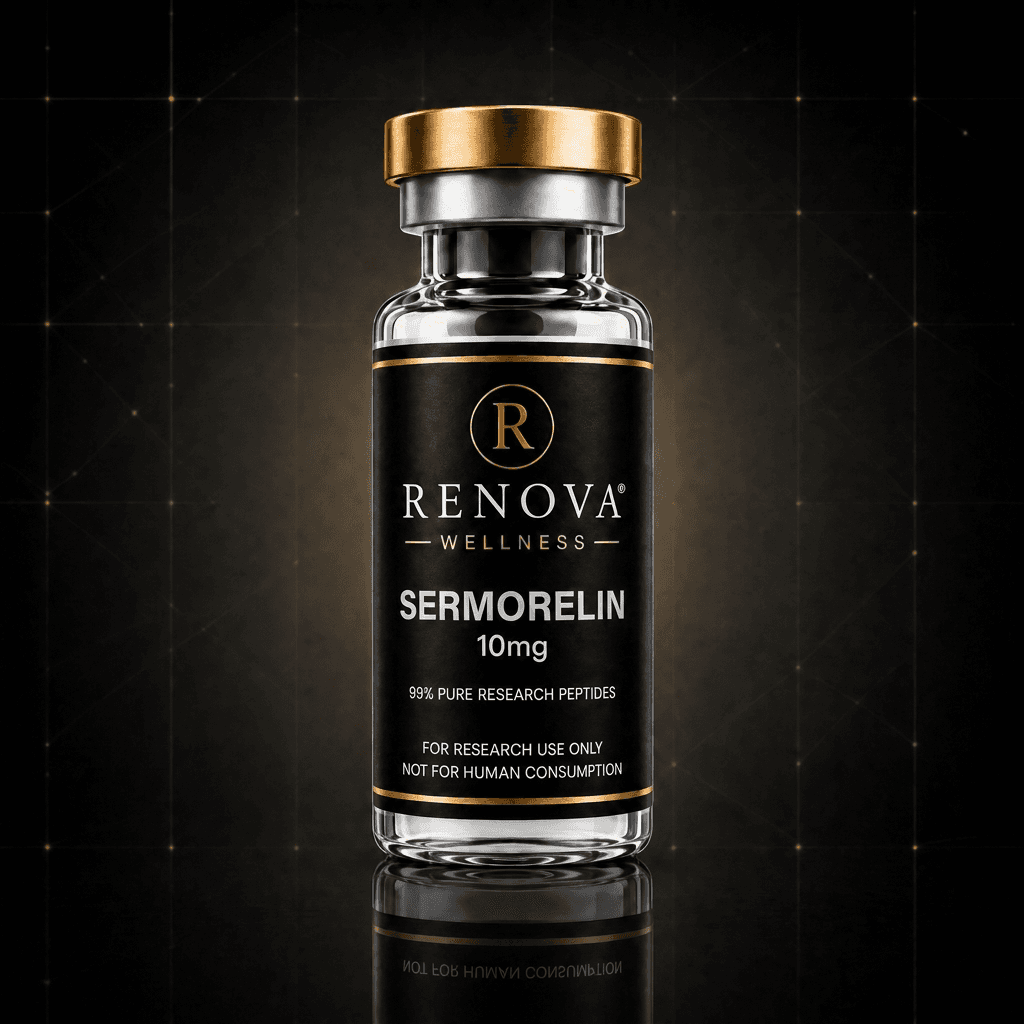
Researchers comparing signaling approaches may also review Sermorelin, which is studied for stimulating endogenous growth-hormone secretion at the pituitary rather than acting directly at IGF-1R.
References
-
Francis GL, Ross M, Ballard FJ, et al. Novel recombinant fusion protein analogues of insulin-like growth factor (IGF)-I indicate the relative importance of IGF-binding protein and receptor binding for enhanced biological potency. J Mol Endocrinol. 1992;8(3):213–223. PMID: 1378742. ↩ ↩2 ↩3 ↩4 ↩5 ↩6 ↩7 ↩8
-
Laajoki LG, Le Breton E, Shooter GK, et al. Secondary structure determination of 15N-labelled human Long-[Arg-3]-insulin-like growth factor 1 by multidimensional NMR spectroscopy. FEBS Lett. 1997;420(1):97–102. PMID: 9450557. ↩
-
Laajoki LG, Francis GL, Wallace JC, Carver JA, Keniry MA. Solution structure and backbone dynamics of long-[Arg(3)]insulin-like growth factor-I. J Biol Chem. 2000;275(14):10009–10015. PMID: 10744677. ↩
-
Denley A, Cosgrove LJ, Booker GW, Wallace JC, Forbes BE. Molecular interactions of the IGF system. Cytokine Growth Factor Rev. 2005;16(4-5):421–439. PMID: 15936977. ↩ ↩2 ↩3
-
Firth SM, Baxter RC. Cellular actions of the insulin-like growth factor binding proteins. Endocr Rev. 2002;23(6):824–854. PMID: 12466191. ↩ ↩2
-
Tomas FM, Knowles SE, Owens PC, et al. Insulin-like growth factor-I (IGF-I) and especially IGF-I variants are anabolic in dexamethasone-treated rats. Biochem J. 1992;282(Pt 1):91–97. PMID: 1371669. ↩
Questions
Frequently Asked
What is IGF-1 LR3?
IGF-1 LR3 (Long R3 IGF-1) is a recombinant 83-amino-acid analog of insulin-like growth factor 1. It carries an arginine substitution at position 3 and a 13-residue N-terminal extension, which together reduce its affinity for IGF-binding proteins and prolong its activity in research settings.
How does IGF-1 LR3 differ from native IGF-1?
The Arg3 substitution and N-terminal extension lower binding to IGFBPs, so more of the analog remains unbound in laboratory models. This is associated with a longer half-life (roughly 20–30 hours) compared with native IGF-1, which is measured in minutes.
What research models has IGF-1 LR3 been studied in?
Preclinical work has examined IGF-1 LR3 in models of cell growth, proliferation, and anabolic signaling through the IGF-1 receptor. These are laboratory and preclinical contexts only.
How is IGF-1 LR3 supplied?
As a lyophilized powder reconstituted with bacteriostatic water for laboratory use and refrigerated (2–8°C) afterward. Renova material ships with a per-batch third-party COA.
Related Compounds
Shop the Research
Compare
Related comparisons
Keep Reading
Related Research
For Research Use Only · Not For Human Consumption · Renova Wellness™