Compound Overviews
What Is GHK-Cu? A Research Overview
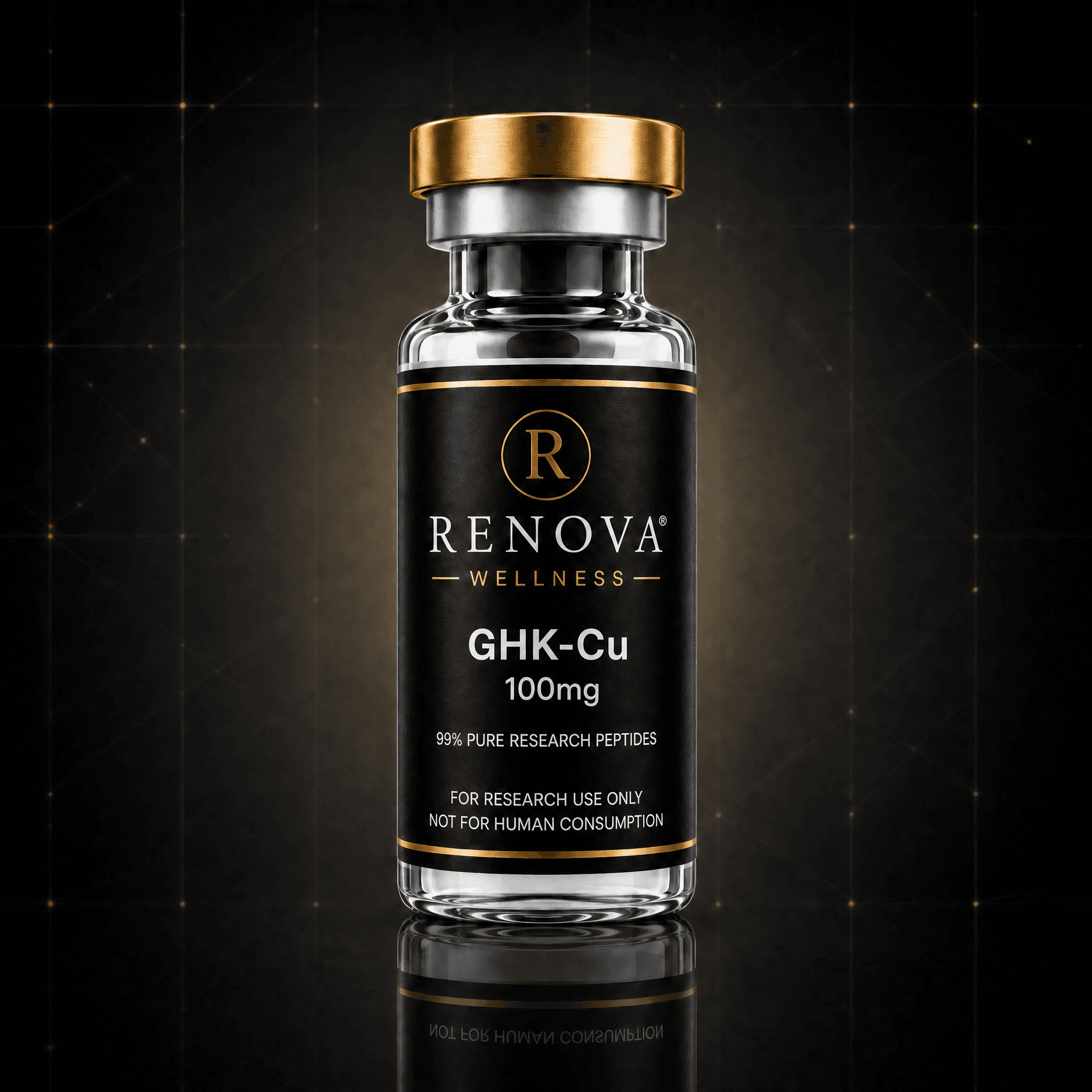
GHK-Cu is a copper-binding tripeptide that has been studied extensively in dermal and tissue-research contexts. This overview is for laboratory reference only.
What is GHK-Cu?
GHK-Cu is the copper(II) complex of the tripeptide glycyl-L-histidyl-L-lysine (Gly-His-Lys) — a short peptide of three amino acids bound to a copper ion. It occurs naturally in human plasma and declines with age, which is part of why it has drawn research interest. The copper ion is integral to the molecule.
| Property | Detail |
|---|---|
| Type | Copper-binding tripeptide |
| Sequence | Gly-His-Lys (GHK) + Cu²⁺ |
| CAS number | 89030-95-5 |
What research has examined
GHK-Cu is one of the longer-studied peptides in this catalog — its biology has been investigated since the 1970s, when the growth-modulating activity of human serum was traced to the glycyl-histidyl-lysine tripeptide.1 The literature is concentrated in dermal and connective-tissue research:
- Collagen and extracellular matrix. In fibroblast-culture studies, GHK-Cu stimulated collagen synthesis at very low (picomolar-to-nanomolar) concentrations,2 and in a rat wound model it was reported to increase connective-tissue accumulation in vivo.3
- Matrix remodeling. Beyond synthesis, GHK-Cu was found to raise matrix metalloproteinase-2 (MMP-2) expression in cultured fibroblasts through a copper-dependent mechanism — a remodeling signal, not just a build-up signal.4
- Gene-expression and "reset" hypotheses. More recent reviews summarize genome-level data describing GHK-Cu's association with a broad set of regenerative and protective pathways, framing it as a modulator of many cellular programs rather than a single-target agent.5
The recurring observation that serum GHK levels decline with age is one reason researchers describe it as a compound of interest in angiogenesis- and skin-aging research. These are cell-culture and animal findings, presented for scientific reference only.
The copper is part of the molecule
A defining feature of GHK-Cu is that the copper(II) ion is not an additive — it is integral to the complex. Much of the peptide's studied activity in matrix and antioxidant contexts is described as copper-dependent,4 which is why the research literature specifies the -Cu complex rather than the bare GHK tripeptide.
Handling in research settings
GHK-Cu is supplied lyophilized and reconstituted with bacteriostatic water before laboratory use, then refrigerated (2–8°C). The copper complex gives solutions a characteristic blue tint, so colour is sometimes used as a rough visual cue — but identity and purity are properly confirmed by the per-batch Certificate of Analysis (HPLC plus mass-spec), not by appearance. Our reconstitution guide covers concentration calculations for any vial size.
What the research does not establish
GHK-Cu's evidence base is predominantly preclinical — fibroblast cultures, animal wound models, gene-expression analyses, and topical cosmetic studies. Controlled clinical evidence for systemic uses is limited, and Renova makes no human-use, cosmetic, or therapeutic claims. The citations below are provided so researchers can consult the primary literature directly.
Often studied in blends
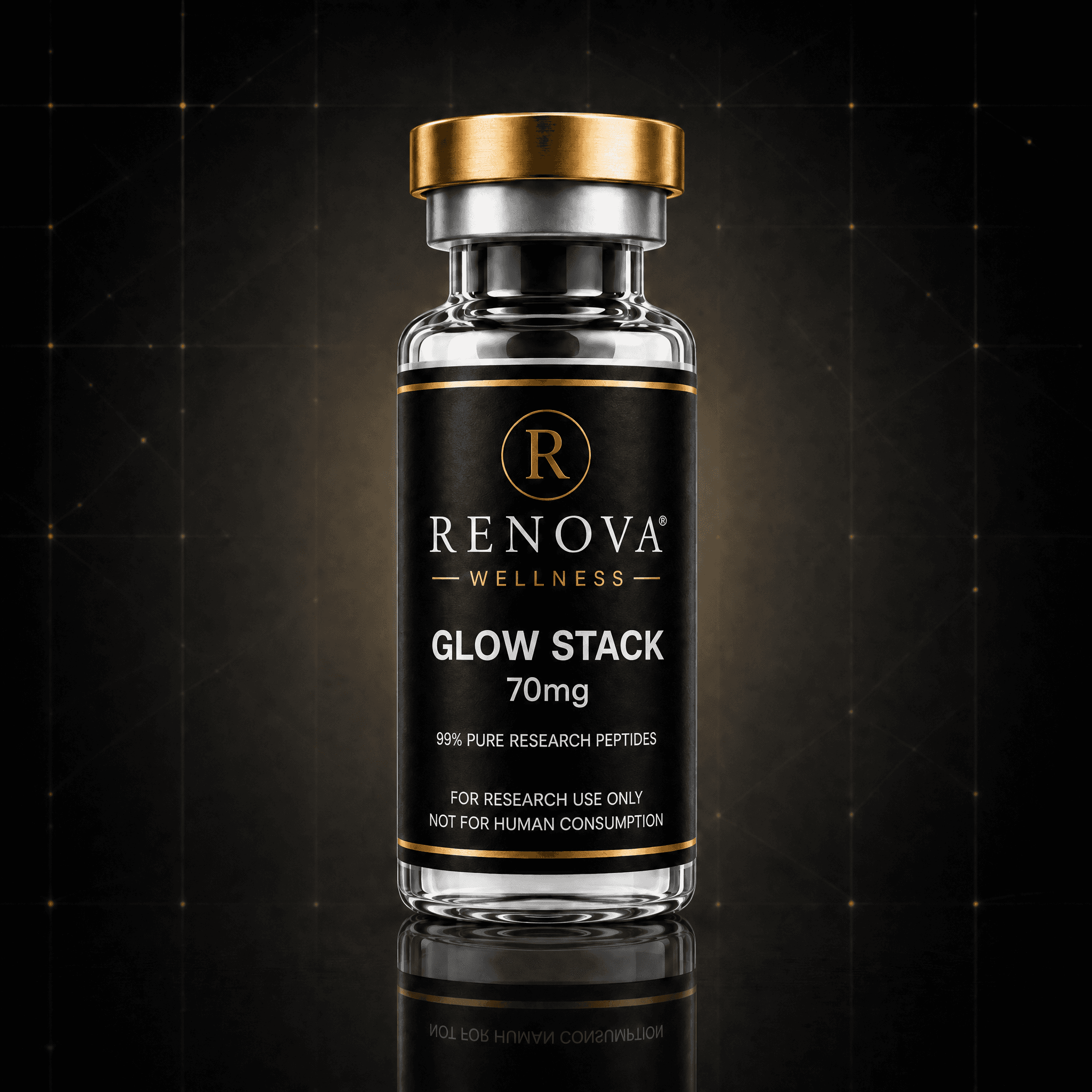
GHK-Cu is one component of the GLOW research blend (with BPC-157 and TB-500), referenced in combined dermal/repair research.
Related comparisons: BPC-157 vs GHK-Cu · GHK-Cu vs Glutathione.
Verified quality
Renova GHK-Cu ships with a per-batch third-party COA. Confirm your lot with Verify Your Vial.
References
-
Schlesinger DH, et al. Growth-modulating serum tripeptide is glycyl-histidyl-lysine. Experientia. 1977;33(3):324–325. PMID: 858356. ↩
-
Maquart FX, et al. Stimulation of collagen synthesis in fibroblast cultures by the tripeptide-copper complex glycyl-L-histidyl-L-lysine-Cu²⁺. FEBS Lett. 1988;238(2):343–346. PMID: 3169264. ↩
-
Maquart FX, et al. In vivo stimulation of connective tissue accumulation by the tripeptide-copper complex glycyl-L-histidyl-L-lysine-Cu²⁺ in rat experimental wounds. J Clin Invest. 1993;92(5):2368–2376. PMID: 8227353. ↩
-
Siméon A, et al. The tripeptide-copper complex glycyl-L-histidyl-L-lysine-Cu²⁺ stimulates matrix metalloproteinase-2 expression by fibroblast cultures. Life Sci. 2000;67(18):2257–2265. PMID: 11045606. ↩ ↩2
-
Pickart L, Margolina A. Regenerative and Protective Actions of the GHK-Cu Peptide in the Light of the New Gene Data. Int J Mol Sci. 2018;19(7):1987. PMID: 29986520. ↩
Questions
Frequently Asked
What is GHK-Cu?
GHK-Cu is a naturally occurring copper-binding tripeptide (glycyl-L-histidyl-L-lysine plus copper), first isolated from human plasma by Loren Pickart in 1973. It is studied in dermal and tissue-regeneration research.
What is GHK-Cu studied for?
Research examines GHK-Cu for collagen and extracellular-matrix signaling, wound-healing models, and markers of cellular senescence in fibroblasts. These are laboratory and preclinical contexts.
Why is GHK-Cu in the GLOW and KLOW blends?
GHK-Cu is the regenerative/dermal component of the GLOW blend (with BPC-157 and TB-500); KLOW adds KPV for an anti-inflammatory arm. See our GLOW guide for the full breakdown.
How is GHK-Cu supplied and stored?
As a lyophilized powder reconstituted with bacteriostatic water for laboratory use and refrigerated (2–8°C) afterward. Every Renova lot ships with a per-batch third-party COA.
Related Compounds
Shop the Research
Compare
Related comparisons
Keep Reading
Related Research
For Research Use Only · Not For Human Consumption · Renova Wellness™