Compound Overviews
The KLOW Stack: GHK-Cu + BPC-157 + TB-500 + KPV — Research Overview
The KLOW stack combines four research peptides whose individually studied pathways — matrix remodeling, angiogenesis, and anti-inflammatory signaling — overlap in preclinical tissue-repair models. This overview is for laboratory and educational reference only.
What is the KLOW stack?
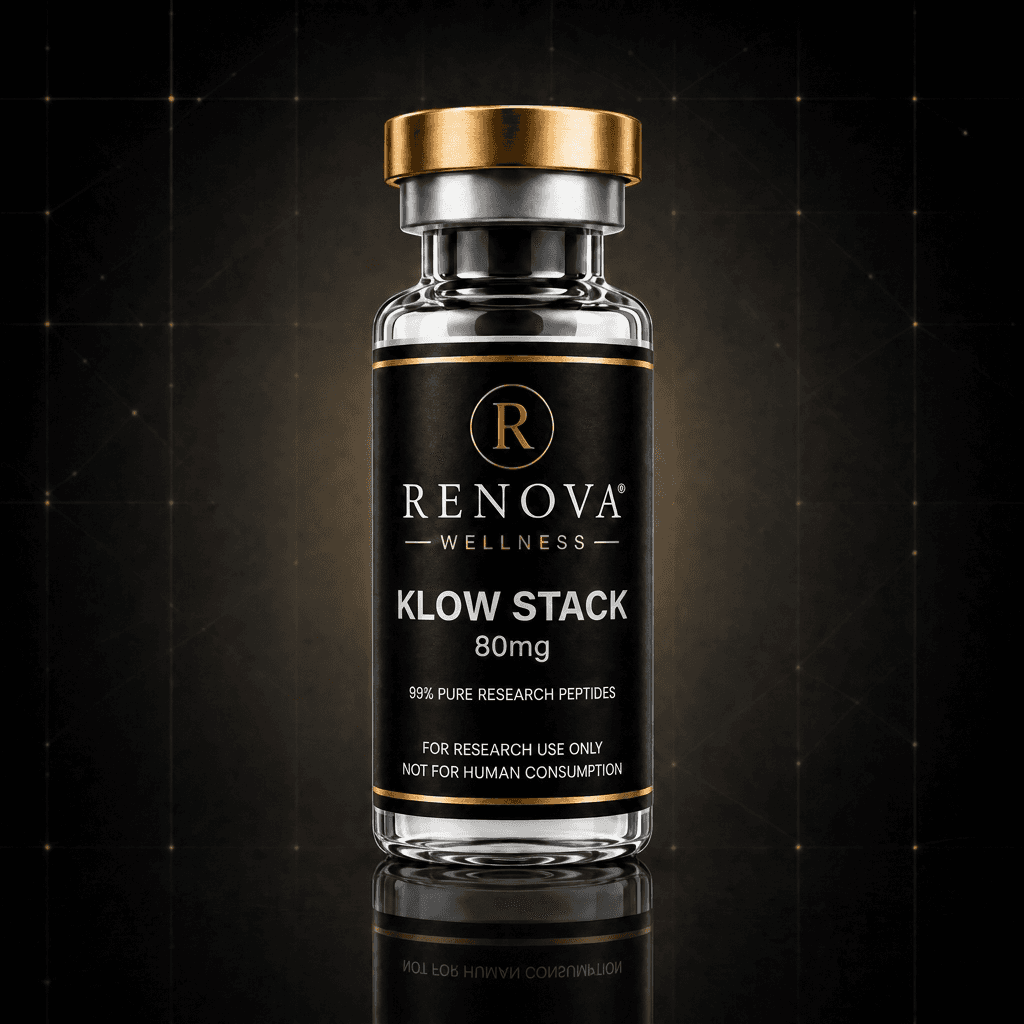
KLOW is the GLOW blend — BPC-157 + GHK-Cu + TB-500 — with KPV added as a fourth component, supplied as a single lyophilized vial. Where GLOW pairs a regenerative copper peptide with two repair-associated peptides, KLOW extends that profile by adding an anti-inflammatory tripeptide. The result is a blend whose components are studied across matrix-remodeling, angiogenic, and anti-inflammatory pathways in preclinical research.
Each component is a distinct, separately characterized peptide with its own literature:
- BPC-157 — a synthetic pentadecapeptide (15 amino acids) derived from a gastric-protein fragment, studied in preclinical tissue-repair, tendon-healing, and cytoprotection models.12 See What Is BPC-157?
- GHK-Cu — a copper-binding tripeptide (Gly-His-Lys + Cu²⁺) studied for collagen synthesis, matrix remodeling, and regenerative signaling associated with the extracellular matrix.345 See What Is GHK-Cu?
- TB-500 — a synthetic fragment related to thymosin β4, studied in models of cell migration, wound reepithelialization, and angiogenesis.67 See What Is TB-500?
- KPV — the C-terminal tripeptide of α-MSH (Lys-Pro-Val), studied for anti-inflammatory activity without the pigmentation effects of the full-length hormone.89 See What Is KPV?
The KLOW name maps cleanly onto that three-plus-one structure: the GLOW base of BPC-157, GHK-Cu, and TB-500, with KPV bolted on as the fourth, anti-inflammatory arm.
Mechanism — cited across the component literature
There is no published study of the four-component KLOW formulation itself. What can be documented is the separate preclinical literature behind each arm, which is the honest basis for any blend rationale. The components are each studied for complementary, largely non-overlapping pathways:
- Tissue repair and cytoprotection (BPC-157). In a tendon-healing model, BPC-157 was reported to promote tendon-fibroblast outgrowth, cell survival, and cell migration in culture.2 In muscle- and tendon-healing work, investigators described adequately modulated angiogenesis — assessed with VEGF, CD34, and FVIII markers — associated with more organized healing than in controls, rather than brute-force vessel stimulation.1
- Matrix remodeling (GHK-Cu). In fibroblast cultures, the tripeptide-copper complex stimulated collagen synthesis at very low concentrations,3 and separately raised matrix metalloproteinase-2 (MMP-2) expression through a copper-dependent mechanism — a remodeling signal, not just a build-up signal.4 Genome-level reviews frame GHK-Cu as a modulator of many regenerative and protective programs rather than a single-target agent.5
- Angiogenesis and cell migration (TB-500 / thymosin β4). A classic wound study reported that adding thymosin β4 increased reepithelialization by roughly 42% at four days in an animal model,6 and in cardiac-development work Tβ4 was described as essential for coronary vessel formation and as promoting neovascularization via the adult epicardium.7
- Anti-inflammatory signaling (KPV). KPV is studied as the C-terminal fragment of α-MSH that retains anti-inflammatory activity without pigmentation effects;8 in a PepT1-transport study it reduced intestinal inflammation in cellular and murine colitis models.9
Researchers study these pathways together because tissue-repair models often involve remodeling, vascularization, and inflammation simultaneously. Adding KPV to the GLOW base is precisely what defines KLOW: it contributes the anti-inflammatory arm to a blend otherwise centered on repair and regeneration.
It is important to distinguish the study of a blend from the study of its parts. Each of the four components has its own separate body of preclinical characterization, cited above and in the individual overviews. Grouping them in one vial reflects a research rationale for examining complementary mechanisms side by side; it does not establish that the combined pathways interact in any particular way.
Research models
Preclinical and laboratory studies involving the KLOW components have examined:
- Tissue repair — tendon-fibroblast outgrowth, cytoprotection, and repair-associated signaling (BPC-157);12 collagen synthesis and matrix remodeling (GHK-Cu).34
- Angiogenesis and migration — wound reepithelialization, cell migration, and neovascularization models (TB-500 / thymosin β4).67
- Inflammation — anti-inflammatory signaling in skin, mucosal, and colitis models (KPV).89
These are strictly laboratory and preclinical research contexts, not established or approved uses. Study of a blend does not imply that its combined effects have been validated in any model.
How it's supplied
Renova supplies the KLOW stack as a single lyophilized powder containing all four peptides. For laboratory work it is reconstituted with bacteriostatic water, then kept refrigerated at 2–8°C. Every unit ships with a per-batch third-party Certificate of Analysis.
Because four peptides share one vial, controlling the reconstituted concentration matters for reproducible work. See Understanding Peptide Reconstitution for the mg-to-mL math and How to Store Research Peptides for cold-chain handling. This describes handling of a research-use-only material — not directions for human or animal use.
Purity & verification
Renova material is third-party tested, with identity and purity documented on a per-batch certificate of analysis (HPLC plus mass spectrometry, with endotoxin screening). For multi-component blends like KLOW, the COA is the primary reference for confirming that a given lot matches its stated composition and purity — appearance alone cannot resolve a four-peptide mixture. See How to Read a Peptide COA and confirm any lot with Verify Your Vial.
What the research does not establish
The most important limitation to state plainly is this: no controlled study has evaluated the KLOW blend as a formulation. Every citation below concerns an individual component — BPC-157, GHK-Cu, thymosin β4/TB-500, or KPV — studied on its own, overwhelmingly in cell cultures and animal models. There is no published evidence that the four peptides in combination interact additively, synergistically, or at all, and no human clinical evidence for the blend or, in most cases, for the components individually.
That gap is characteristic of research blends generally: they are assembled from separate single-agent literatures, so the combined-formulation studies that would validate a stack simply do not exist. Renova makes no human-use, cosmetic, safety, efficacy, or therapeutic claims of any kind. The references are provided so researchers can consult the primary single-component literature directly and judge the rationale on its own terms.
To compare the base blend and the individual arms, see the GLOW stack, KPV, and GHK-Cu; the two repair peptides are also studied together in the Wolverine blend (BPC-157 + TB-500).
References
-
Brcic L, et al. Modulatory effect of gastric pentadecapeptide BPC 157 on angiogenesis in muscle and tendon healing. J Physiol Pharmacol. 2009;60 Suppl 7:191–196. PMID: 20388964. ↩ ↩2 ↩3
-
Chang C-H, et al. The promoting effect of pentadecapeptide BPC 157 on tendon healing involves tendon outgrowth, cell survival, and cell migration. J Appl Physiol (1985). 2011;110(3):774–780. PMID: 21030672. ↩ ↩2 ↩3
-
Maquart FX, et al. Stimulation of collagen synthesis in fibroblast cultures by the tripeptide-copper complex glycyl-L-histidyl-L-lysine-Cu²⁺. FEBS Lett. 1988;238(2):343–346. PMID: 3169264. ↩ ↩2 ↩3
-
Siméon A, et al. The tripeptide-copper complex glycyl-L-histidyl-L-lysine-Cu²⁺ stimulates matrix metalloproteinase-2 expression by fibroblast cultures. Life Sci. 2000;67(18):2257–2265. PMID: 11045606. ↩ ↩2 ↩3
-
Pickart L, Margolina A. Regenerative and Protective Actions of the GHK-Cu Peptide in the Light of the New Gene Data. Int J Mol Sci. 2018;19(7):1987. PMID: 29986520. ↩ ↩2
-
Malinda KM, et al. Thymosin beta4 accelerates wound healing. J Invest Dermatol. 1999;113(3):364–368. PMID: 10469335. ↩ ↩2 ↩3
-
Smart N, et al. Thymosin beta-4 is essential for coronary vessel development and promotes neovascularization via adult epicardium. Ann N Y Acad Sci. 2007;1112:171–188. PMID: 17495252. ↩ ↩2 ↩3
-
Brzoska T, et al. Alpha-melanocyte-stimulating hormone and related tripeptides: biochemistry, antiinflammatory and protective effects in vitro and in vivo, and future perspectives for the treatment of immune-mediated inflammatory diseases. Endocr Rev. 2008;29(5):581–602. PMID: 18612139. ↩ ↩2 ↩3
-
Dalmasso G, et al. PepT1-mediated tripeptide KPV uptake reduces intestinal inflammation. Gastroenterology. 2008;134(1):166–178. PMID: 18061177. ↩ ↩2 ↩3
Questions
Frequently Asked
What is the KLOW stack?
KLOW is the GLOW blend — BPC-157, GHK-Cu, and TB-500 — with KPV added as a fourth component. It combines matrix-remodeling, angiogenic, and anti-inflammatory pathways studied across preclinical tissue-repair and inflammation models.
How is KLOW different from GLOW?
GLOW is the three-peptide blend of BPC-157, GHK-Cu, and TB-500. KLOW is that same blend plus KPV, which adds an anti-inflammatory arm derived from the C-terminal fragment of α-MSH.
What research models is the KLOW stack associated with?
The individual components are studied in preclinical models of tissue repair and inflammation, spanning matrix remodeling, angiogenesis, and anti-inflammatory signaling. These are laboratory and preclinical contexts only. No study has evaluated the four-component KLOW formulation itself.
How is the KLOW stack supplied?
As a lyophilized powder reconstituted with bacteriostatic water for laboratory use and refrigerated (2–8°C) afterward. Renova material ships with a per-batch third-party COA.
Related Compounds
Shop the Research
Compare
Related comparisons
Keep Reading
Related Research
For Research Use Only · Not For Human Consumption · Renova Wellness™