Compound Overviews
What Is TB-500? A Research Overview
TB-500 is a frequently studied research peptide related to a naturally occurring protein called Thymosin Beta-4. This overview summarizes what it is and what research has examined — for laboratory reference only.
What is TB-500?
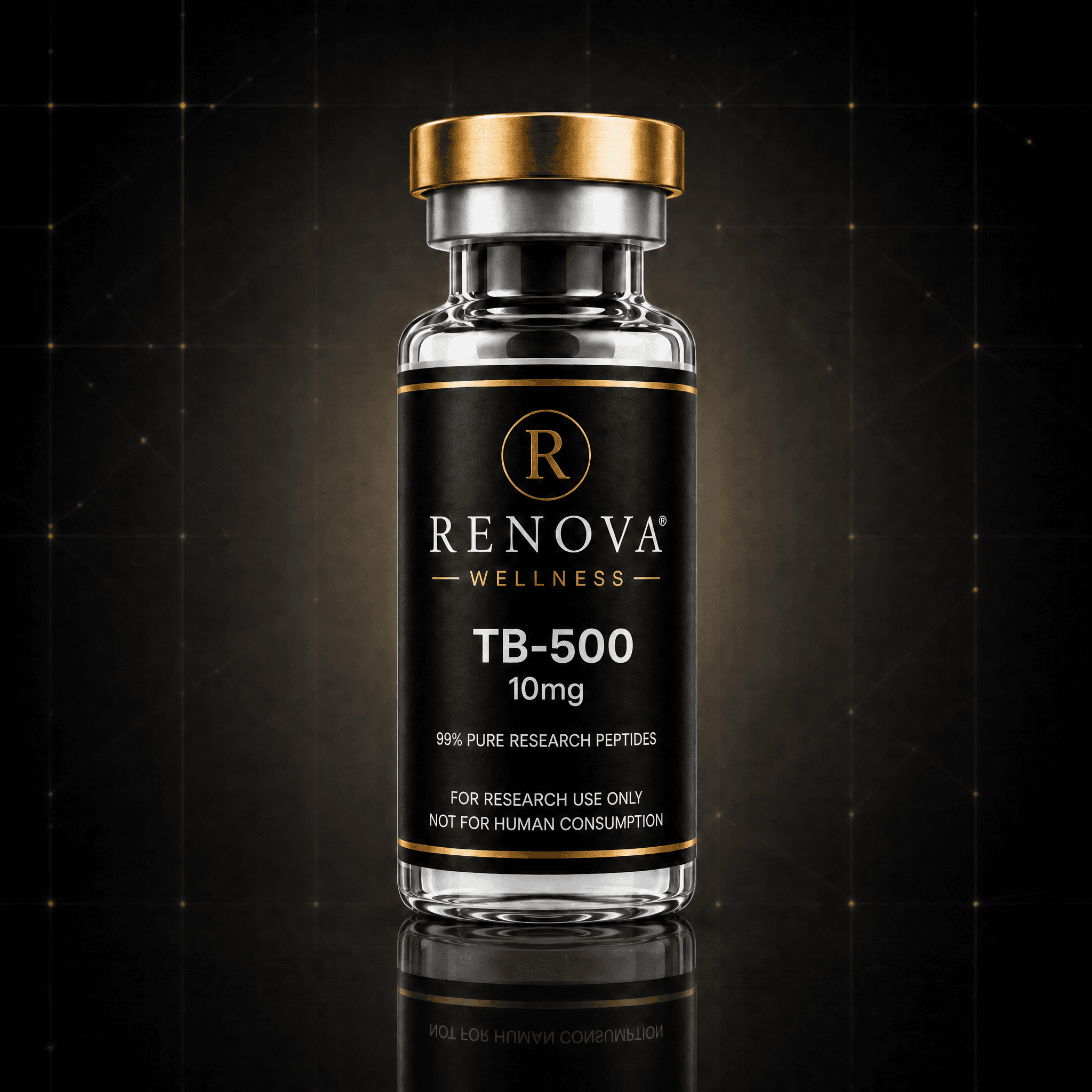
TB-500 is a synthetic peptide corresponding to an active region of Thymosin Beta-4 (Tβ4), a naturally occurring protein involved in cellular processes such as actin regulation. Because Tβ4 itself is large, research often uses the shorter TB-500 fragment. The name "TB-500" is used mainly in the research-material market for this fragment, whereas the primary scientific literature usually refers to thymosin β4 (Tβ4) itself — a distinction worth keeping in mind when reading the sources cited below.
What research has examined
Laboratory and animal-model studies of Thymosin Beta-4 / TB-500 have explored:
- Cell migration — Tβ4's role in actin binding and the movement of cells, a process relevant to tissue-repair research.1
- Wound-model research — a classic study reported that adding Tβ4 increased reepithelialization by roughly 42% at 4 days and up to 61% at 7 days post-wounding in an animal model.2
- Angiogenesis — formation of new blood vessels; Tβ4 has been described as essential for coronary vessel development and as promoting neovascularization via the adult epicardium in cardiac models.3
As with all preclinical research, these findings describe controlled laboratory observations and are presented for scientific reference only.
The actin connection
The defining biochemical feature of Thymosin Beta-4 is that it is the major actin-sequestering molecule in many mammalian cells — it binds monomeric (G-)actin and helps regulate assembly of the actin cytoskeleton.1 Because cytoskeletal remodeling underlies how cells move, investigators have studied Tβ4 (and the TB-500 fragment) in the context of cell migration, extracellular-matrix deposition, and the coordinated steps of experimental tissue repair. It is this mechanism — not a hormone-like receptor action — that most of the peptide's recovery-research literature is built around.
Cardiac and vascular research
A distinct branch of the literature examines Tβ4 in the heart. In developmental and injury models it has been described as essential for coronary vessel formation and as a paracrine signal that prompts epicardium-derived cells to migrate inward and contribute to new vasculature.3 Related work has paired Tβ4 with cardiac-reprogramming factors in repair-focused studies.4 Broader reviews frame Tβ4 as a multifunctional tissue-repair and regeneration peptide across several organ systems.5 These are animal- and cell-model findings reported by investigators — not clinical outcomes in humans.
TB-500 vs full-length Thymosin β4
"TB-500" typically refers to a synthetic fragment corresponding to the biologically active region of Tβ4, whereas "Thymosin β4" is the full 43-amino-acid protein. Much of the primary literature studies the full protein; researchers reference the shorter fragment largely for practical, laboratory-handling reasons. Supplied lyophilized and reconstituted with bacteriostatic water, it is handled like other research peptides; those assessing solution stability also consider a compound's half-life.
What the research does not establish
The TB-500 / Tβ4 record is predominantly preclinical. Controlled human clinical evidence is limited, and Renova makes no human-use, safety, or performance claims of any kind. The references below are provided so researchers can consult the primary sources directly and judge them on their own terms.
Often studied alongside BPC-157
TB-500 and BPC-157 are frequently referenced together in tissue-repair research — the basis for the combined "Wolverine" research blend. See our BPC-157 vs TB-500 comparison.
Handling and reconstitution in the lab
TB-500 is supplied as a lyophilized (freeze-dried) powder and reconstituted with bacteriostatic water before laboratory use; reconstituted vials are refrigerated (2–8°C). Because a synthetic fragment is easier to manufacture consistently and handle at scale than the full 43-residue protein, most research-material suppliers work with the TB-500 fragment — one practical reason it, rather than full-length Tβ4, appears across the catalog. As with any research peptide, reproducibility hinges on controlling the reconstituted concentration and the cold chain; our reconstitution guide and storage guide walk through the mg-to-mL math and handling, and researchers comparing compounds also weigh a peptide's half-life in solution. This describes laboratory handling of a research-only material — not directions for human or animal use.
Purity and verification
Every batch of Renova TB-500 ships with a published third-party COA reporting HPLC purity and labeled-vs-actual content. Confirm your lot with Verify Your Vial.
References
-
Goldstein AL, Hannappel E, Kleinman HK. Thymosin β4: actin-sequestering protein moonlights to repair injured tissues. Trends Mol Med. 2005;11(9):421–429. ↩ ↩2
-
Malinda KM, et al. Thymosin beta4 accelerates wound healing. J Invest Dermatol. 1999;113(3):364–368. PMID: 10469335. ↩
-
Smart N, et al. Thymosin beta-4 is essential for coronary vessel development and promotes neovascularization via adult epicardium. Ann N Y Acad Sci. 2007;1112:171–188. PMID: 17495252. ↩ ↩2
-
Srivastava D, et al. Cardiac repair with thymosin β4 and cardiac reprogramming factors. Ann N Y Acad Sci. 2012;1270:66–72. PMID: 23050819. ↩
-
Philp D, Kleinman HK. Animal studies with thymosin beta, a multifunctional tissue repair and regeneration peptide. Ann N Y Acad Sci. 2010;1194:81–86. PMID: 20536453. ↩
Questions
Frequently Asked
What is TB-500?
TB-500 is a synthetic peptide related to Thymosin Beta-4, a naturally occurring protein involved in cell migration and the regulation of actin. It is studied in animal models of tissue repair.
How is TB-500 different from BPC-157?
Both are studied in recovery research but by different mechanisms: TB-500 relates to Thymosin Beta-4 and actin/cell-migration pathways, while BPC-157 is a gastric-derived pentadecapeptide studied for angiogenesis and tissue repair. They are often studied together in the Wolverine blend.
What does the TB-500 research show?
The literature is largely preclinical, examining cell migration, wound healing, and tissue repair in animal and cell models. Human clinical data is limited.
How is TB-500 supplied and stored?
As a lyophilized powder reconstituted with bacteriostatic water for laboratory use and refrigerated (2–8°C) afterward. Every Renova lot ships with a per-batch third-party COA.
Related Compounds
Shop the Research

Compare
Related comparisons
Keep Reading
Related Research
For Research Use Only · Not For Human Consumption · Renova Wellness™