Compound Overviews
Kisspeptin-10: HPG-Axis Signaling Peptide — Research Overview
Kisspeptin-10 is a short neuroendocrine signaling peptide studied for its central role in a key regulatory axis. This overview is for laboratory and educational reference only.
What is Kisspeptin-10?
Kisspeptin-10 is the C-terminal decapeptide of kisspeptin, the family of peptides encoded by the KISS1 gene. The parent protein — a 145-amino-acid precursor — is proteolytically processed into several fragments (kisspeptin-54, -14, -13, and -10); the shared, biologically active C-terminal portion is what the shorter Kisspeptin-10 represents.1
Its sequence is Tyr-Asn-Trp-Asn-Ser-Phe-Gly-Leu-Arg-Phe-NH₂ (YNWNSFGLRF-NH₂), a C-terminally amidated decapeptide. Reference identifiers used in the literature and catalog documentation include CAS 374675-21-5 and a molecular weight of approximately 1302.5 Da. As a short synthetic peptide of ten amino acids, it is produced by solid-phase synthesis.
| Property | Detail |
|---|---|
| Type | RFamide decapeptide (KISS1 C-terminal fragment) |
| Sequence | Tyr-Asn-Trp-Asn-Ser-Phe-Gly-Leu-Arg-Phe-NH₂ |
| CAS number | 374675-21-5 |
| Molecular weight | ~1302.5 Da |
| Receptor | KISS1R (GPR54) |
The KISS1 gene was originally identified in a different research context — as a metastasis-suppressor gene — before its peptide products were matched to their receptor.2 Two groups reported in 2001 that KISS1-derived peptides were the endogenous ligands of the orphan G-protein-coupled receptor then known as GPR54.12 The longer kisspeptin fragments and the shorter Kisspeptin-10 share the same active C-terminal region, which is why the decapeptide is used as a compact, fully receptor-active form in laboratory work — in the original characterizations, the C-terminal decapeptide retained the receptor-activating potency of the longer parent peptides.1 The terminal Arg-Phe-NH₂ motif is characteristic of the RFamide peptide family to which kisspeptins belong.
Mechanism
Kisspeptin-10 is an agonist of KISS1R, a G-protein-coupled receptor historically identified as the orphan receptor GPR54.1 In cell-based assays, kisspeptin binding drives KISS1R signaling through the Gq/phospholipase-C pathway, mobilizing intracellular calcium.1 Activation of KISS1R is a central upstream event in the neuroendocrine signaling cascade that research associates with regulation of the hypothalamic-pituitary-gonadal (HPG) axis.3
The genetic link came from human and mouse studies published in 2003: loss-of-function disruption of the GPR54/KISS1R receptor was associated with a failure of normal HPG-axis maturation in both a human cohort and knockout mice, establishing the receptor as a gatekeeper of the axis in these models.34 Complementary work traced the signal downstream — in rodent models, kisspeptin was reported to act on GnRH neurons and to directly stimulate gonadotropin-releasing hormone (GnRH) release via GPR54,5 with kisspeptin administration raising circulating gonadotropins in the mouse.6 In this sense the peptide functions as an upstream neuroendocrine secretagogue — it prompts the release of a downstream hormone rather than acting as that hormone itself.
A notable pharmacokinetic feature reported in research characterizations is a very short half-life — on the order of a few minutes for the native decapeptide. This rapid clearance is a defining feature of the peptide and shapes how it is studied in time-course experiments, where investigators must account for how quickly the peptide is cleared from a model system. Because the decapeptide is a direct agonist of the receptor, it is often used as a tool to probe the receptor's role rather than the broader upstream regulation.
Research models
Preclinical and laboratory studies involving kisspeptin signaling have examined:
- Receptor pharmacology — KISS1R/GPR54 agonism, ligand binding, and downstream Gq/calcium signaling in transfected cell systems.1
- HPG-axis regulation — genetic models in which GPR54/KISS1R disruption impairs normal axis maturation.34
- GnRH-neuron activation — rodent studies of kisspeptin acting directly on GnRH neurons to trigger release.5
- Gonadotropin-releasing signaling — kisspeptin administration and the resulting gonadotropin response in the mouse.6
These are strictly laboratory and preclinical research contexts, not established or approved uses. Findings in cell systems and animal models characterize receptor pharmacology and signaling; they do not translate to any human or animal application and are not evidence of any outcome outside the laboratory.
How it's supplied
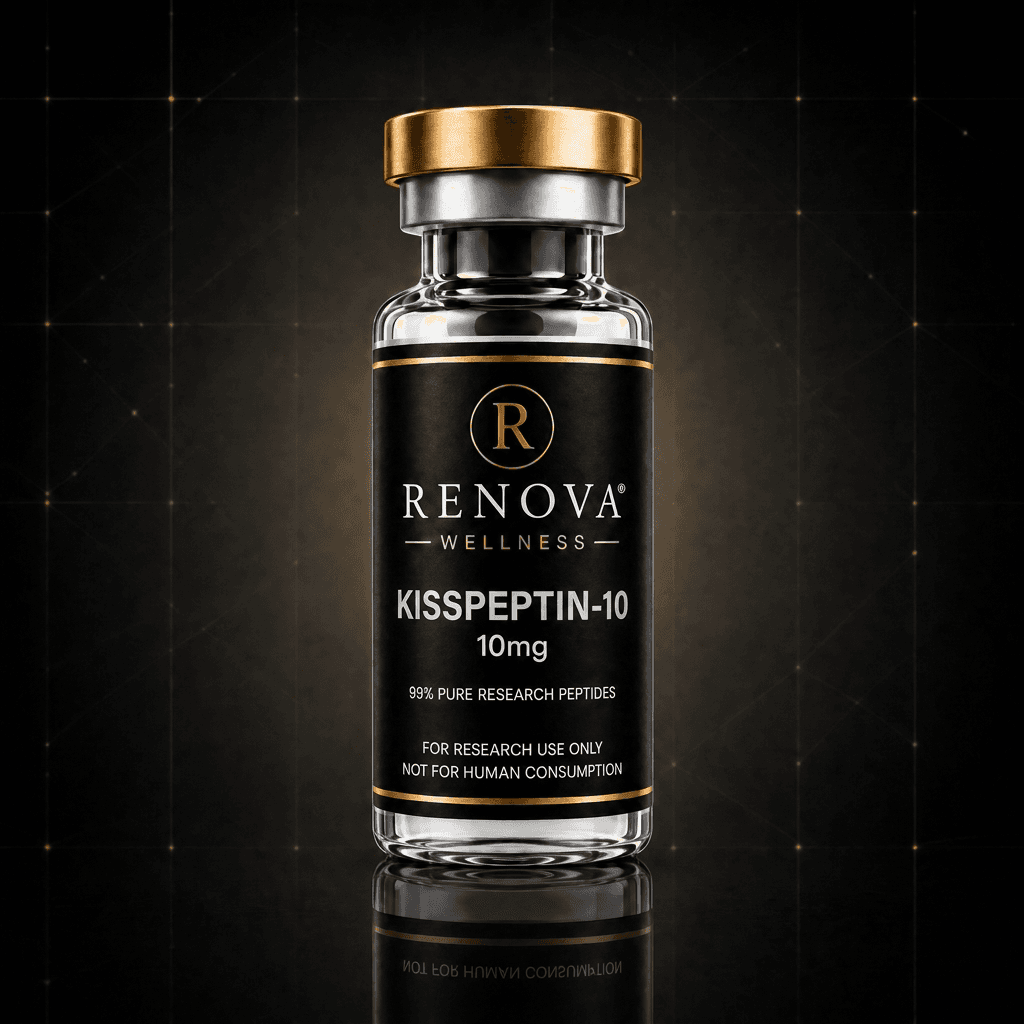
Renova supplies Kisspeptin-10 as a lyophilized powder. For laboratory work it is reconstituted with bacteriostatic water, then kept refrigerated at 2–8°C. Every unit ships with a per-batch third-party COA.
See Understanding Peptide Reconstitution and How to Store Research Peptides for general handling references, and the reconstitution calculator for working out concentrations at any vial size. Because the native peptide clears rapidly, careful attention to reconstitution and cold storage is especially relevant when preparing time-course experiments.
Purity & verification
Renova material is third-party tested, with identity and purity documented on a per-batch certificate of analysis. For short synthetic peptides like Kisspeptin-10, that certificate — typically combining HPLC purity with mass spectrometry identity confirmation — is the primary reference for verifying that a given lot matches its stated sequence, mass, and purity. See How to Read a Peptide COA and Why Peptide Purity Matters, and confirm any lot with Verify Your Vial.
What the research does not establish
The kisspeptin literature is built on cell-based receptor assays, genetic knockout models, and animal studies, together with a smaller number of human physiology investigations characterizing the axis.7 These describe receptor pharmacology and neuroendocrine signaling — they are not evidence of safety, efficacy, or any benefit for a research-use-only compound outside those contexts. Renova makes no human-use, clinical, or therapeutic claims for Kisspeptin-10, and nothing here should be read as dosing or medical guidance. The citations below are provided so researchers can consult the primary literature directly.
Verified quality
Renova Kisspeptin-10 ships with a per-batch third-party COA. Confirm your lot with Verify Your Vial.
References
-
Kotani M, Detheux M, Vandenbogaerde A, et al. The metastasis suppressor gene KiSS-1 encodes kisspeptins, the natural ligands of the orphan G protein-coupled receptor GPR54. J Biol Chem. 2001;276(37):34631–34636. PMID: 11457843. ↩ ↩2 ↩3 ↩4 ↩5 ↩6
-
Ohtaki T, Shintani Y, Honda S, et al. Metastasis suppressor gene KiSS-1 encodes peptide ligand of a G-protein-coupled receptor. Nature. 2001;411(6837):613–617. PMID: 11385580. ↩ ↩2
-
de Roux N, Genin E, Carel JC, et al. Hypogonadotropic hypogonadism due to loss of function of the KiSS1-derived peptide receptor GPR54. Proc Natl Acad Sci U S A. 2003;100(19):10972–10976. PMID: 12944565. ↩ ↩2 ↩3
-
Seminara SB, Messager S, Chatzidaki EE, et al. The GPR54 gene as a regulator of puberty. N Engl J Med. 2003;349(17):1614–1627. PMID: 14573733. ↩ ↩2
-
Messager S, Chatzidaki EE, Ma D, et al. Kisspeptin directly stimulates gonadotropin-releasing hormone release via G protein-coupled receptor 54. Proc Natl Acad Sci U S A. 2005;102(5):1761–1766. PMID: 15665093. ↩ ↩2
-
Gottsch ML, Cunningham MJ, Smith JT, et al. A role for kisspeptins in the regulation of gonadotropin secretion in the mouse. Endocrinology. 2004;145(9):4073–4077. PMID: 15217982. ↩ ↩2
-
Dhillo WS, Chaudhri OB, Patterson M, et al. Kisspeptin-54 stimulates the hypothalamic-pituitary gonadal axis in human males. J Clin Endocrinol Metab. 2005;90(12):6609–6615. PMID: 16174713. ↩
Questions
Frequently Asked
What is Kisspeptin-10?
Kisspeptin-10 is the C-terminal decapeptide fragment of the KISS1-derived kisspeptin family. It acts as an agonist of the KISS1R receptor (also called GPR54) and is studied in research for its role in regulating the hypothalamic-pituitary-gonadal (HPG) axis.
What receptor does Kisspeptin-10 act on?
Kisspeptin-10 is an agonist of KISS1R, historically identified as the orphan receptor GPR54. Activation of this receptor is central to the neuroendocrine signaling studied in kisspeptin research.
What research models has Kisspeptin-10 been studied in?
Preclinical and laboratory research has examined kisspeptin signaling in the context of HPG-axis regulation and gonadotropin-releasing signaling. These are laboratory and preclinical contexts only.
How is Kisspeptin-10 supplied?
As a lyophilized powder reconstituted with bacteriostatic water for laboratory use and refrigerated (2–8°C) afterward. Renova material ships with a per-batch third-party COA.
Related Compounds
Shop the Research
Keep Reading
Related Research
For Research Use Only · Not For Human Consumption · Renova Wellness™